
Let’s be brutally honest: a brilliant coder without project management skills is like a Ferrari engine loose in a garage—powerful, but going nowhere fast. Software Project Management is the subject that installs the steering wheel, the brakes, and the map. This past paper isn’t about memorizing Gantt charts; it’s your simulation for leading a team from a blurry idea to a shipped product, on time and on budget, without burning everyone out.
Forget the myth that this is the “soft” or “easy” option. This is where technical skill meets human psychology, economics, and high-stakes logistics. It’s the hardest kind of engineering: people-engineering.
What This Paper Actually Measures: Your Readiness to Lead
1. The Foundation: It’s All About Trade-Offs
The first section often hits you with the Iron Triangle: Scope, Time, Cost. You won’t just define it; you’ll wrestle with it.
“Your client wants to add a major feature two weeks before launch. Analyze the impact using the triangle and propose a professional response.”
This tests if you see a project as a dynamic system, where pulling one lever forces movement in another.
2. The Methodologies: Choosing Your Weapon
This isn’t a theoretical comparison. The paper presents real, messy scenarios:
- Waterfall: When is its rigid structure actually an advantage? (Hint: Think safety-critical systems, strict regulatory environments).
- Agile/Scrum: How do you handle a stakeholder who demands a fixed deadline and a fixed feature set for an Agile project? You’ll break down sprints, define user stories, and calculate velocity.
- Hybrid Models: The real world isn’t pure. You might design a “Wagile” approach for a hardware-software integration project.
3. The Numbers: Your Financial & Temporal Toolkit
Get ready for calculations—this is where many engineers zone out, and it’s exactly why they fail to become managers.
- Estimation Techniques: Function Point Analysis, COCOMO, Story Points. You’ll be given data and asked: “Estimate the effort for this module using Use Case Points.”
- Earned Value Management (EVM): The heart of tracking. You’ll calculate CV (Cost Variance), SV (Schedule Variance), CPI, and SPI from a table of numbers. A negative CV isn’t just a number—it’s a story of a project bleeding money, and you need to diagnose why.
- Critical Path Method (CPM): You’ll draw a network diagram, find the critical path, and calculate float. This is the science of sequencing.
4. The Human Factor: Where Plans Meet Reality
Plans are perfect. Teams are human. The paper probes your emotional intelligence:
- Team Dynamics & Leadership: How do you motivate a team during a death march? What’s the difference between leading experts and guiding juniors?
- Stakeholder Management: Mapping stakeholders on a Power/Interest grid and crafting communication plans for each quadrant.
- Risk Management: You won’t just list risks. You’ll perform qualitative analysis (Probability/Impact matrix) and quantitative analysis (Expected Monetary Value), then devise mitigation and contingency plans.
5. The Quality & The Process: Building the Right Thing, Right
- Quality Assurance vs. Quality Control: Defining metrics, planning tests, and integrating QA into the lifecycle, not just at the end.
- Configuration Management & Version Control: Treating code, docs, and designs as controlled assets.
- Ethics & Professional Responsibility: What do you do when a manager asks you to fake a progress report? Your professional duty is part of the mark scheme.
The Paper’s Ultimate Test: Synthesis Under Pressure
The hardest questions are the case studies. You’re given a project post-mortem—a tale of missed deadlines, blown budgets, and a demoralized team—and asked: “What were the three key management failures, and what would you have done differently at Months 1, 3, and 5?” This tests if you can diagnose a multi-system failure and prescribe a credible recovery plan.
How to Conquer This Past Paper:
- Think Like a CEO-in-Training. For every concept, ask: “What decision does this inform? What’s the cost of being wrong?”
- Practice the Math Until It’s Instinctual. EVM and CPM calculations should be as automatic as writing a
forloop. Exam stress amplifies mathematical hesitation. - Use the “FRAME” Method for Essay Questions:
- Facts: Restate the scenario.
- Rule: Name the principle/methodology.
- Analysis: Apply it to the facts.
- Mitigate: Address risks or downsides.
- Example: Give a brief, concrete illustration.
- Draw Diagrams Everywhere. Network diagrams, burn-down charts, stakeholder maps. A good diagram often earns more marks than a paragraph.
- Balance the Hard and Soft. Your answer to a scheduling problem must include the numbers and a note on how you’d communicate the new timeline to the team to maintain morale.
This past paper is your leadership audition. It separates those who can only build components from those who can ship a system. It proves you understand that the hardest part of software isn’t the code—it’s the coordinated effort of people, money, and time to make the code matter. Master it, and you stop being just a developer. You become a builder.
Mid Term Examination 2021
Q1: Explain the Following terms
- Scope creep
- Work package
- Three point estimate
- Slack/float time
Q2: Consider table below. All duration estimates are in days, and the network proceed from node 1 to node 8.
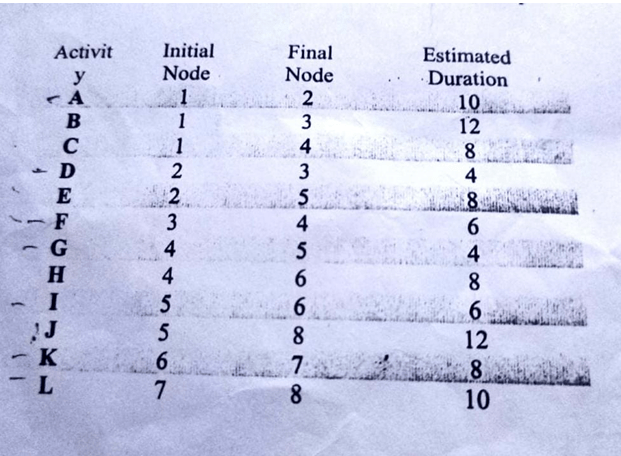
- Draw an AOA network diagram representing the project. (Put the node number in circle and draw arrows from node to node, labeling each arrow with the activity letter and estimate time.)
- Identify all of the paths on the network diagram and note how long they are?
- What is the critical path for this project and how long is it?
- What is the shortest possible time needed to complete this project?
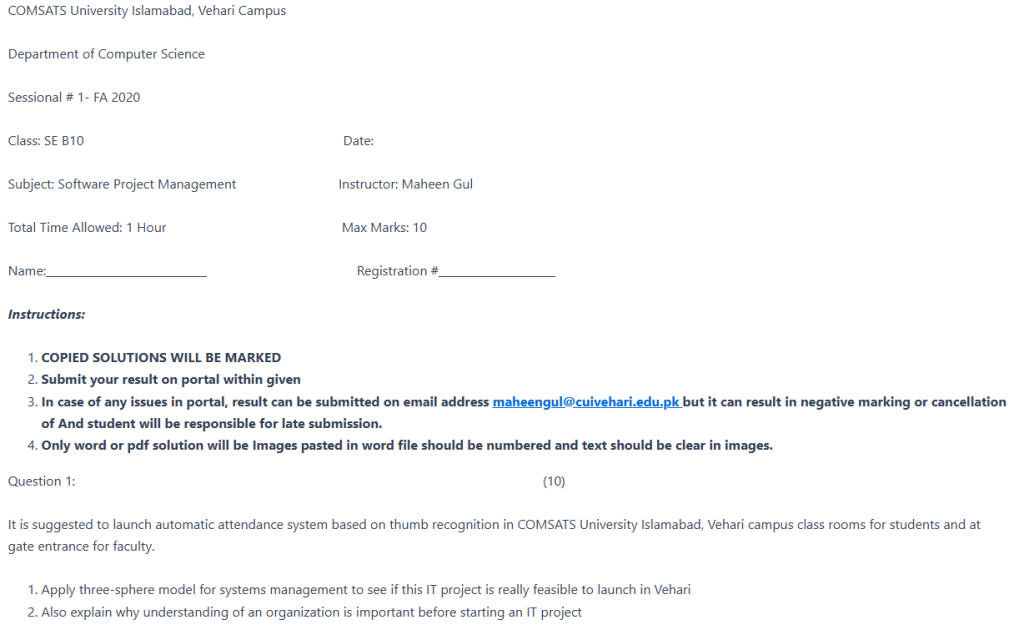
Sessional 1 question paper 2020
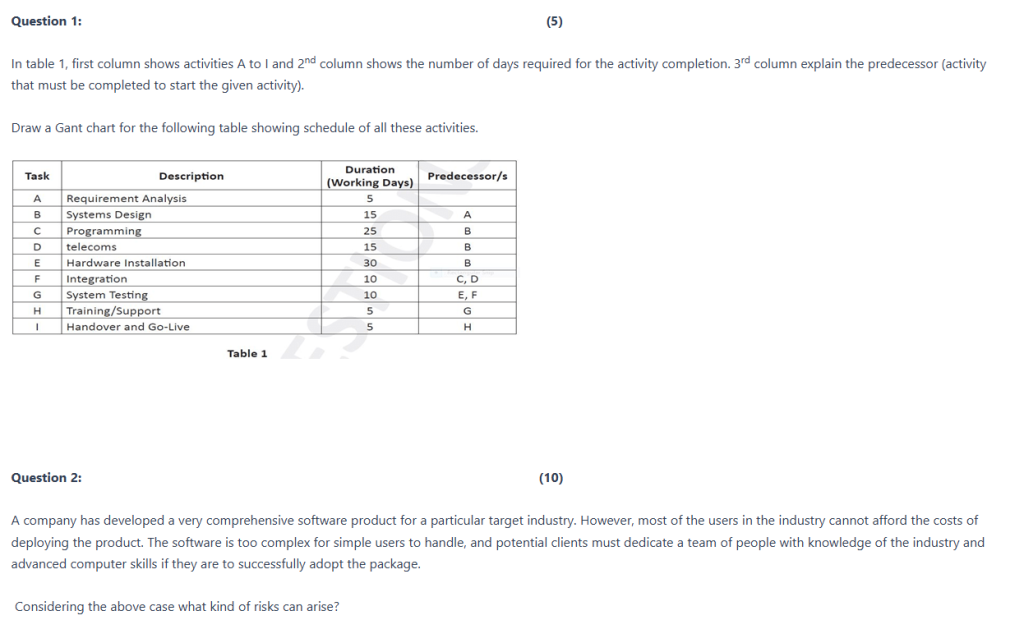
Sessional 2 question paper 2020
Final question paper 2020
A company has developed a very comprehensive software product for a particular target industry. However, most of the users in the industry cannot afford the costs of deploying the product. The software is too complex for simple users to handle, and potential clients must dedicate a team of people with knowledge of the industry and advanced computer skills if they are to successfully adopt the package.
Considering the above case what kind of risks can arise?
Final question paper 2020
Class: BSSE B10 Date:
Subject: Software Project Management Instructor: Maheen Gul
Total Time Allowed: 1.5 hours Max Marks: 40
Name: _____________________ Registration #________________
Instructions:
Read question paper carefully.
“JUSTIFY YOUR ANWSERS ACCORDING TO MARKS”
Case 1: A project is estimated to be finished in one year, using two programmers. However, due to a change in circumstances, it is desirable that the project be speeded up. A proposal is put forward to increase the number of programmers to six, thus allowing the project to be completed in 4 months.
Question 1: Considering the case 1:
- What would be the risk, if the project committee does not come up with any new proposal to cope the change in circumstances and stick to one-year plan despite of changes in circumstances? (10)
- What would be the risk, if the project committee allows the project to be completed in 4 months according to new proposal? (10)
Case 2: You and your team are working on the Recreation and Wellness Intranet Project. You have been asked to refine the existing cost estimate for the project so they can evaluate supplier bids and have a solid cost baseline for evaluating project performance. Your schedule and cost goals are to complete the project in six months for under $200,000.
Question 2: Assume that you have completed three months of the project. The BAC was $200,000 for this six-month project. You can also make the following assumptions: PV= $120,000, EV=$100,000 AC=$90,000 (10)
2.1 Use the CPI to calculate the estimate at completion (EAC) for this project. Is the project performing better or worse than planned?
Question 3: Considering case 2, assume testing is done for 6 weeks and that you’ll need one senior tester for all six weeks, two junior testers for the last four weeks, two user-group workers for the first week, four user-group workers for the last three weeks, and two user-group managers for the last two weeks. Create a resource histogram to show how many people you think the project will need for testing.