
Let’s be unequivocal about this: English Comprehension and Composition in a Computer Science department is not a “soft” elective. It is the core communication layer upon which all your technical expertise depends. This past paper is not about literature; it’s a stress test for your ability to decode complex information, synthesize it, and recode it into clear, persuasive, and professional human language. It tests the single most important skill for your career: turning intricate technical ideas into common knowledge.
Forget grammar drills in isolation. This is about precision, clarity, and impact in a technical world.
What This Paper Actually Processes: Your Professional Communication Stack
1. Comprehension: The Input Parser
The first half tests your “lexical analysis” for human language. Can you accurately parse meaning?
- Critical Reading of Technical Texts: You’ll be given a passage on a complex topic (e.g., “The Ethical Implications of Algorithmic Bias”) and tested not on recall, but on inference, tone, argument structure, and logical consistency.
- Summarization & Précis Writing: The ultimate test of understanding. Can you distill a 500-word technical argument into a 100-word summary that captures the thesis, key evidence, and conclusion without distortion? This is the skill behind writing executive summaries and documentation abstracts.
- Interpretation of Data in Text: Understanding how an author uses statistics, examples, and analogies to build a case. Identifying assumptions, strengths, and flaws in an argument.
2. Composition: The Output Generator
This is where you compile your thoughts into executable instructions for a human reader.
- Technical and Professional Writing:
- The Formal Report/Proposal: Structuring a document with clear headings (Introduction, Methodology, Findings, Conclusion, Recommendations). Writing with an objective, evidence-based tone.
- The Technical Description/Process Explanation: Explaining a system (e.g., “How a Blockchain Works”) to a non-specialist audience. Using clear analogies, logical sequencing, and defining jargon.
- The Persuasive Argument (Position Paper): Staking a claim (“Agile is superior to Waterfall for startup software development”) and defending it with logical reasoning, credible evidence, and refutation of counter-arguments.
- Audience Awareness: The golden rule. You’ll be asked to write about the same technical topic (e.g., “Cloud Security”) for two different audiences: a technical lead (using terms like “encryption at rest,” “zero-trust architecture”) and a business client (using terms like “data protection,” “compliance risk,” “service reliability”). This tests your ability to modulate vocabulary, detail, and perspective.
- Structure and Cohesion: Your writing must have a thesis statement, topic sentences, logical paragraph transitions, and a conclusion that does more than just restate—it synthesizes or calls to action.
3. The Syntax and Semantics Layer: Grammar for Precision
In tech, ambiguous language causes bugs—in systems and in projects.
- Advanced Grammar for Clarity: Mastering modifier placement, parallel structure, active vs. passive voice, and conciseness. Not for its own sake, but to eliminate ambiguity. (e.g., “The manager praised the programmer using the new software.” Who was using the software?).
- Punctuation as Logic: Using semicolons, colons, and dashes to control the flow of complex ideas and lists, especially when describing systems or specifications.
- Vocabulary for Nuance: Choosing the exact word. Differentiating between “verify” and “validate,” “error” and “failure,” “efficient” and “effective.”
4. The Practical CS Connection
This subject is applied directly to your field. Expect tasks like:
- Writing a Software Requirement Specification (SRS) Fragment: With unambiguous, testable criteria.
- Drafting a User Story or Bug Report: That is clear, reproducible, and actionable.
- Crafting a Professional Email: To a professor, a client, or a team member—navigating tone, request clarity, and professional etiquette.
- Documenting Code or an API: Writing clear comments and user-facing documentation that explains the why, not just the what.
The Paper’s Ultimate Challenge: The Integrated Analysis and Response
The most demanding question will present a technical article or case study followed by a multi-part prompt:
- Summarize the author’s central argument in one paragraph.
- Analyze the effectiveness of one piece of evidence used.
- Compose a formal email to the author posing a critical question that extends the discussion.
- Write a brief persuasive counter-argument or supporting argument on a specific sub-point.
This tests comprehension, critical thinking, professional communication, and argumentative writing in one sustained task.
How to Master This Past Paper:
- Read Like a Writer, Not Just a Student. When you read any technical article, ask: What is the thesis? How is each paragraph built? How does the writer transition? Reverse-engineer good writing.
- Practice the “Summary in One Sentence” Drill. For any complex concept you learn in CS, force yourself to explain it in one, clear, grammatical sentence. This builds precision.
- Outline Relentlessly. Never start writing an essay answer without a 5-minute outline. Know your thesis, your 2-3 main points, and your conclusion before you write word one.
- Master the “So What?” Test. For every claim or fact you state, ask yourself “So what?” and answer it. This forces analytical depth and moves you from description to analysis.
- Edit for Brevity and Punch. Your first draft is for getting ideas out. Your second draft is for cutting 20% of the words. Eliminate vague phrases (“very,” “in terms of”), redundant expressions, and weak verbs.
This past paper is your professional communication benchmark. It certifies that you can be the interface between complex technology and the people who need to understand it, fund it, use it, or be affected by it. Passing it means you’re not just a clever problem-solver in code; you are an effective communicator in the human world where all technology must ultimately live and have impact.
English comprehension and composition Fall 21 in final paper
Question No. 1. Write short answers of the following questiona
a. Define noun and write any two types of noun.
b. Define reflexive pronoun and give one example.
c. Define adverb and enlist any types of adverb.
d. Enlist any four types of business correspondence,
e. Define job application and write two types of job application
SECTION-B SUBJECTIVE (Marks: 40)
Question No. 2.
Define listening and explain kinds of listening in detail.
Question No. 3.
Define speaking and explain purpose of speaking in detai
Question No. 4.
Define reading and explain principles of reading in detail
Question No. 5.
Write a detailed note on rules of effective writing.
English comprehension and composition Sessional I in past paper
Q1: Write a paragraph on any ONE of the following topics (300-500 words).
- The cate
- Mercy
- Rivers
- Cricket
Q2: Change the voice (active/passive) of the following.
- The cat killed the mouse.
- The boy was bitten by a dog.
- The boy made a kite.
- The ship was burned.
- The thief was caught.
- He is loved by all.
- The sudden noise frightened the horse.
- The young man made a disturbance at the meeting.
- The captive was bound to a tree.
- We compelled the enemy to surrender.
Q3: In the following sentences, separator the subject and the predicate.
- The cackling of geese saved Rome.
- The body stood on the burning deck.
- Tubal Cain was a man of might.
- Stone walls do not make a prison.
- The singing of the birds delights us.
- Miss kitty was rude at the table one day.
- He has a good memory.
- Bad habits grow unconsciously.
- Edison invented the phonograph.
- We cannot pump the ocean dry.
English comprehension and composition sessional II in past paper
Question No. 1. Write short answers of the following questions. (2×5=10)
sentences? Give 1 example for each.
- Write down the kinds of sentences.
- What is the function of imperative and exclamatory
(2) c. Write a short note on adjective and its degrees. (2)
- Differentiate hearing and listening (2)
- Change the voice of the following: 1. Why did the police catch the boy? (1)
- The truth is spoken by him. (1)
SECTION-B SUBJECTIVE (Marks: 10)
Question No. 2.
Write a comprehensive note on punctuation marks and their use with relevant examples (10)
English comprehension and composition Final paper
Question No.1
Correct the following sentences (1×5-05)
The purpose of there visit was political.
The types of information are quiet different.
Two and two makes four.
She is working in this office since 2009. He is my big brother. (v)
Change the voice of the following sentences (1×5-05)
Open the window. The car is being washed by Al
She wrote a letter.
I cannot do this work.
Write the one word substitution of the following
(1×4-04)
A place where one lives permanently The act of intentionally killing oneself
A woman whose spouse is dead
A geometrical figure with eight sides
SECTION-B
LONG ANSWER QUESTIONS
Attempt any three. (Marks: 3×12=36)
Question No. 2 Write a comprehensive note on SQ3R’S in writing skill.
Question No. 3 What is “Précis” and what are rules of Précis writing give your answer in detail.
Question No. 4 Write a detailed note on Presentation Skills. Question No. 5 what is the importance of Business Writing and what are rules to convey
good news and bad news.
English comprehension and composition Final fall 2021
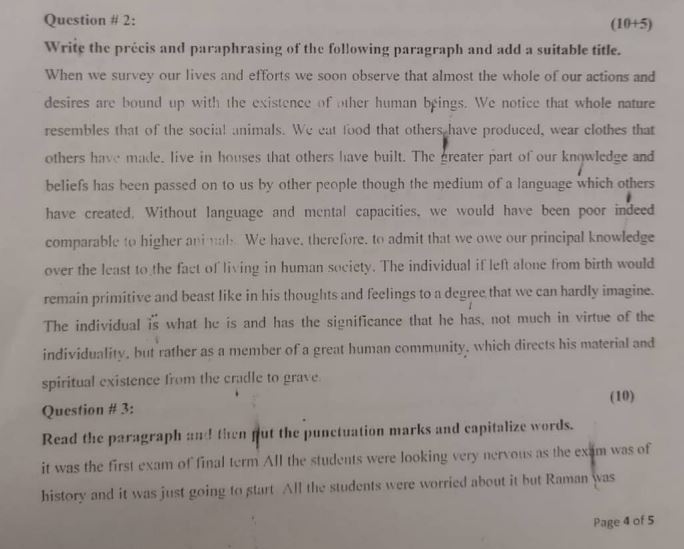
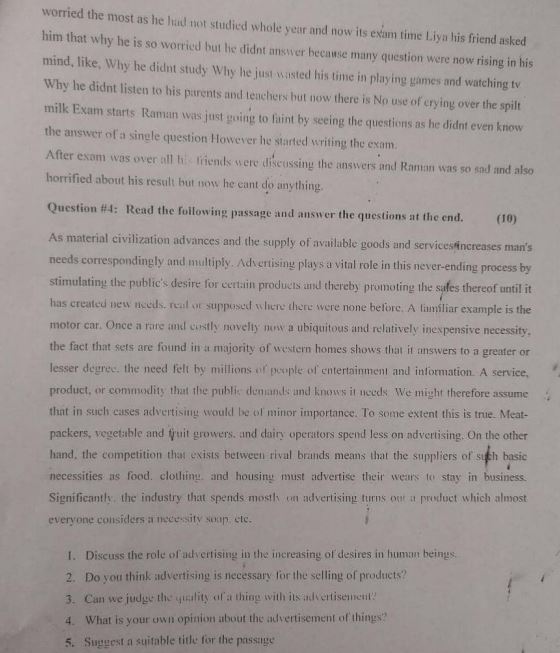
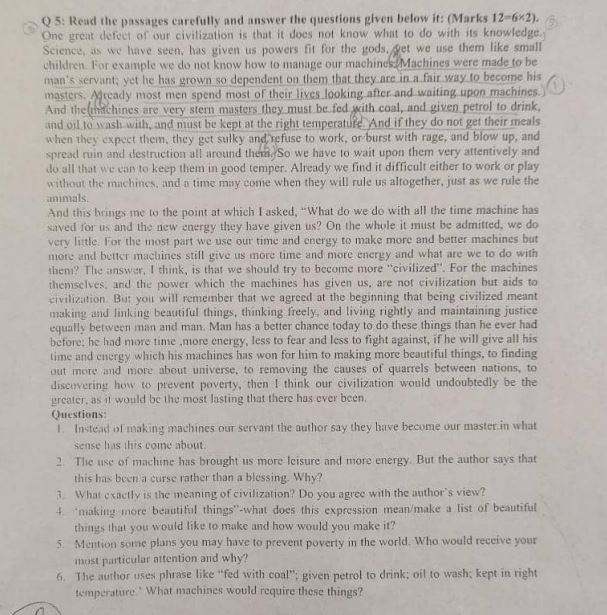
Question No. 1. Write short answers of the following questions.
a. What are the four main parts of sentence? (2×5-10)
b. Define modifier and give an example.
c. What are the four main objectives of listening? d. What are the four main steps in active listening process?
e. Define narrative essay and give an example.
SECTION-B
SUBJECTIVE (Marks: 10)
Question No. 2.
Define reading, discuss types of reading in detail and give examples.
(2+8=10)