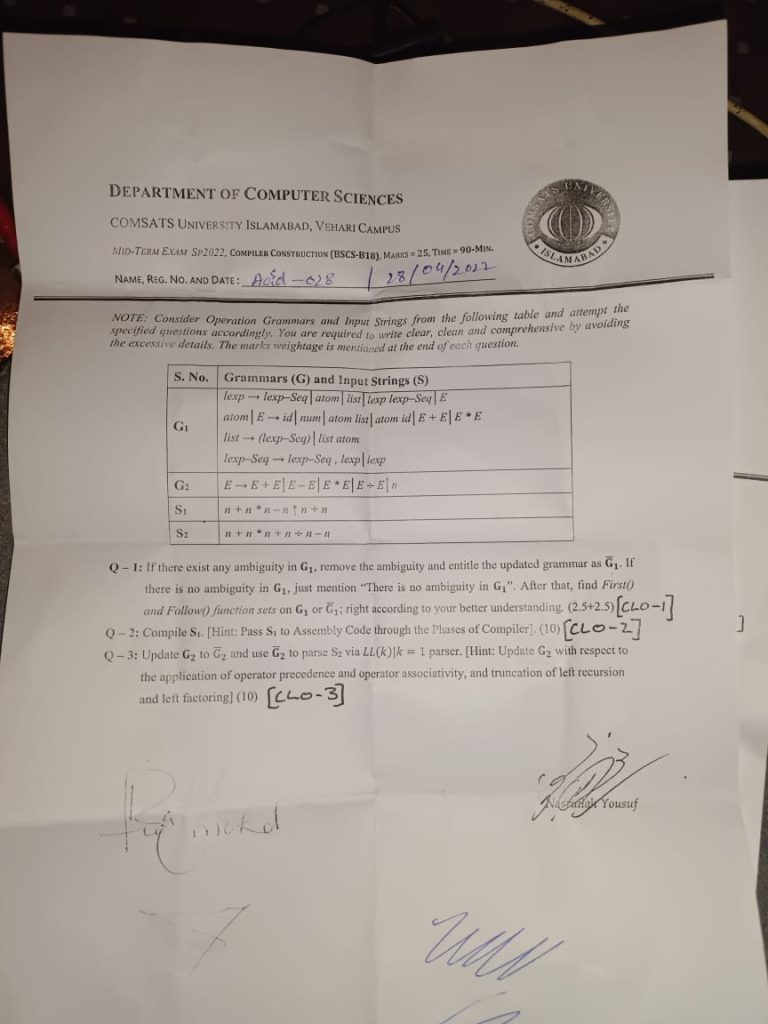
Let’s define this with absolute clarity: Compiler Construction is not just another course. It is the supreme synthesis of nearly every core subject in computer science. This past paper is your final exam in computational translation. It tests whether you can take the abstract elegance of a programming language and engineer a pipeline that grinds it down into the raw, efficient instructions that make silicon sing.
Forget writing apps. This is about building the tool that makes writing apps possible. It’s where theory (automata, grammars), data structures (trees, hash tables), algorithms (graph coloring), and sheer engineering grit converge.
What This Paper Actually Compiles: Your Mastery of the Translation Pipeline
1. The Grand Architecture: The Phases of a Compiler
You must have the multi-stage pipeline etched in your mind. Each phase transforms the representation of the program, feeding the next.
Phase 1: The Front-End – From Text to Structure
- Lexical Analysis (Scanning): Breaking the raw character stream into tokens (keywords, identifiers, operators). You’ll design regular expressions for tokens and understand how a finite automaton (DFA) implements the scanner.
- Syntax Analysis (Parsing): The heart of understanding structure. You’ll use Context-Free Grammars to define language syntax.
- You’ll construct parse trees and abstract syntax trees (ASTs).
- You’ll know the difference between top-down parsing (LL, recursive descent) and bottom-up parsing (LR, LALR). You’ll be able to compute FIRST and FOLLOW sets and build parsing tables.
- Semantic Analysis: Adding meaning. Using the symbol table (a core data structure you must understand inside-out) to perform type checking, scope resolution, and enforcing language rules (e.g., “break statement not within a loop”).
Phase 2: The Middle-End – The Optimizer’s Playground
- Intermediate Code Generation: Translating the AST into a machine-independent, low-level representation like three-address code or quadruples. You’ll be asked to generate IR for given source code constructs.
- Optimization: This is where compilers earn their keep. You’ll apply local and global optimizations:
- Local: Constant folding, common subexpression elimination, dead code elimination within a basic block.
- Global: Data-flow analysis within control flow graphs (CFGs). You’ll perform liveness analysis to determine when variables are alive, which directly leads to…
Phase 3: The Back-End – From IR to Machine Code
- Code Generation: Mapping the IR onto the target machine’s instruction set architecture (ISA). You’ll handle instruction selection and register allocation—one of the hardest problems.
- Register Allocation: You’ll use graph coloring to map an unlimited set of virtual registers to a finite set of physical registers, spilling to memory when necessary. You must be able to construct an interference graph from liveness information.
- Peephole Optimization: A final, cheap pass over the generated assembly to replace inefficient instruction sequences.
2. The Crucial Supporting Cast: Runtime Systems
A compiler doesn’t work in a vacuum. You must understand the environment it creates:
- Memory Management: The layout of activation records/stack frames for function calls, including how to handle parameters, return addresses, and local variables.
- Garbage Collection (for managed languages): Basic concepts of mark-and-sweep vs. reference counting.
3. The Advanced Toolkit: Handling Real Languages
- Error Handling & Recovery: How does the parser recover from a syntax error to find more errors? (e.g., panic-mode recovery).
- Object-Oriented Features: Compiling classes, inheritance (
vtables), and dynamic dispatch.
The Paper’s Ultimate Challenge: The Multi-Phase Transformation
The hardest questions are end-to-end problems that force you to walk a program through multiple stages:
“For the following code snippet:
c
int i, s = 0;
for (i=0; i<10; i++) {
    s = s + i*i;
}
a) List the tokens generated by the scanner.
b) Draw the parse tree (or AST).
c) Generate three-address code.
d) Construct the control flow graph and perform liveness analysis on the loop body.
e) Show the final assembly code for a simple register architecture, assuming two available registers.”
This tests your integrated understanding of the entire pipeline.
How to Master This Past Paper:
- Internalize the Pipeline. Be able to draw the full compiler diagram from memory, with the inputs and outputs of each phase. This is your roadmap.
- Think in Trees and Graphs. The AST and the Control Flow Graph are your primary mental models. Practice drawing them for small code snippets until it’s instinctive.
- Practice the “Algorithms” of Each Phase. Scanning is a DFA. Top-down parsing is a pushdown automaton. Register allocation is graph coloring. Treat each phase as an algorithm implementation problem.
- Trace Data Flow. For optimization questions, manually trace variable values and liveness across basic blocks. Use a table to track definitions (
d) and uses (u). - Connect to Pre-Requisites. See Automata Theory in the scanner/parser. See Data Structures in the symbol table and graph algorithms. See Computer Architecture in the instruction selection. This subject is the capstone.
This past paper is your engineering final for the science of translation. It proves you understand, at a deep level, how the bridge between human-readable code and machine-executable bits is actually built. Passing it means you don’t just use programming languages—you understand their lifecycle from birth to execution.
Complier construction Fall 21 Past paper
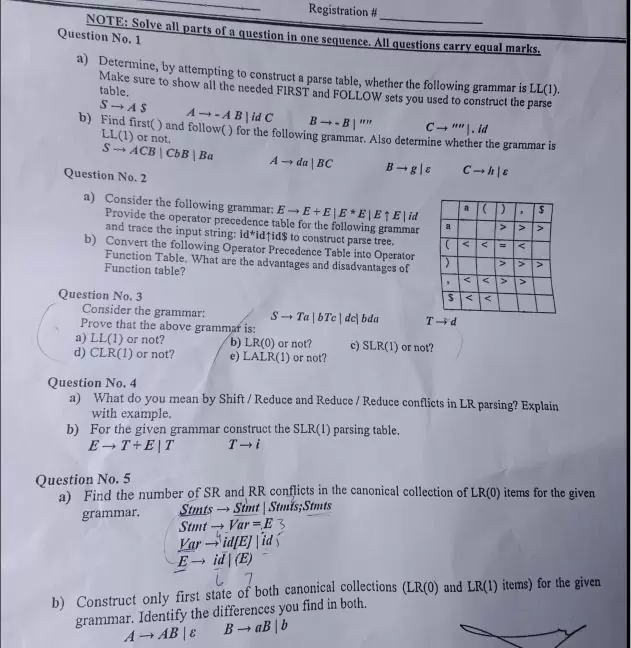
Complier construction Mid Term Exam 2021
- C# language is used for which kind of application.
- Design regular expression for relational operators.
- Design a regular expression for constants (digits plus floating point numbers):
- Defined EOF.
- Difference between compiler and interpreter.
- How to find the tokens/variables that are the ending symbols of a grammar with code.
- Defined tokens.
- Difference between Lexical Analyzer Syntax analysis.
- Design a regular expression for finding all the words starting with „t‟ and „m‟ in the following document.
- Defined Symbol Table.
- Defined hash table.
- How to find the tokens/variables that are the starting symbols of a grammar WITH CODE.
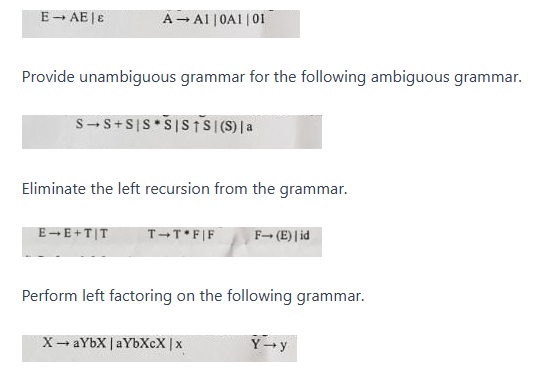
Q1:
Prove that the following grammar is ambiguous or not.
Q2:
- Construct the LL (1) parsing table for the following grammar. Also show the working of parsing algorithm to draw parse tree for the string int + int + int $.
Eà TX Xà +E | € Tà (E) | int Y Yà *T | €
- Find first () and follow () for the following grammar. Also determine whether the grammar is LL (1) or not?
Sà ACB| CbB |Ba Aà da | BC Bà g | € Cà h | €
Q3:
Write a program to implement the recursive decent parser for the following grammar.
E à a + T Tà(E)|a