
Let’s face it: in the rush of coding, debugging, and building, “Professional Practices” can feel like the dry, obligatory chapter you skim before the exam. But this past paper reveals the truth—this isn’t a side subject. It’s the rulebook for the real world, where the stakes aren’t just marks, but careers, reputations, and the very impact of technology on society.
This paper moves you out of the IDE and into the boardroom, the courtroom, and the ethical grey zones of tech. It tests not what you can build, but how you should build it, for whom, and at what cost.
What This Exam Actually Covers (And Why It Matters):
1. Ethics in the Trenches
Forget vague philosophy—these are scenario-based questions.
“Your client asks for a feature that compromises user privacy. Justify your response.”
“You discover a critical bug post-launch. Outline your steps.”
This is about decision-making under pressure, where there’s rarely one “correct” answer, only well-reasoned and professionally defensible ones.
2. The Law as a Tool, Not a Threat
Intellectual Property, Data Protection Acts (like GDPR), Cybercrime legislation—you’re not expected to be a lawyer, but you must know the guardrails. Questions often present a project lifecycle and ask: “At which points should legal review occur, and why?” This frames law as part of the development lifecycle, not an afterthought.
3. Project Management—Beyond Gantt Charts
It’s not just about defining Agile vs. Waterfall. It’s about applying them:
“Given this stakeholder conflict, which methodology would improve communication, and how?”
“Calculate the CV (Cost Variance) and SV (Schedule Variance) from this data. Is the project in trouble?”
This is practical numeracy and people skills, tested together.
4. Professionalism & Sustainability
From codes of conduct (ACM/IEEE) to green computing and accessibility standards. The paper asks: “How does professional duty extend beyond the client to society and the environment?” This is where you see the profession’s conscience on the page.
The Paper’s Unique Challenge:
There are few “plug-and-chug” formulas here. Success lies in structured argumentation, clear justification, and applied principles. The marking scheme often awards points for logical flow and consideration of multiple stakeholders—not just a bullet-point answer.
How to Use This Past Paper Wisely:
- Think in Cases. Treat each question as a mini case study. Read tech news—real-world examples of data breaches, ethical AI debates, or project failures will give you concrete material to enrich your answers.
- Practice the “Framework” Approach. For ethics questions, explicitly state the principle you’re using (e.g., “Applying the principle of least harm…”). For law, cite the specific act. For management, name the methodology. This shows systematic thinking.
- Write for the Audience. Assume your examiner is a smart, non-technical manager. Explain your reasoning without jargon. Clarity and professionalism in your writing style are being assessed.
This paper is your rehearsal for the moments that define a career. It’s not about memorizing statutes—it’s about building the judgment to navigate the complex, human world in which your code will live. Mastering it means you’re not just a developer; you’re a professional.
Professional practices in IT (PPIT) all previous/ past question papers
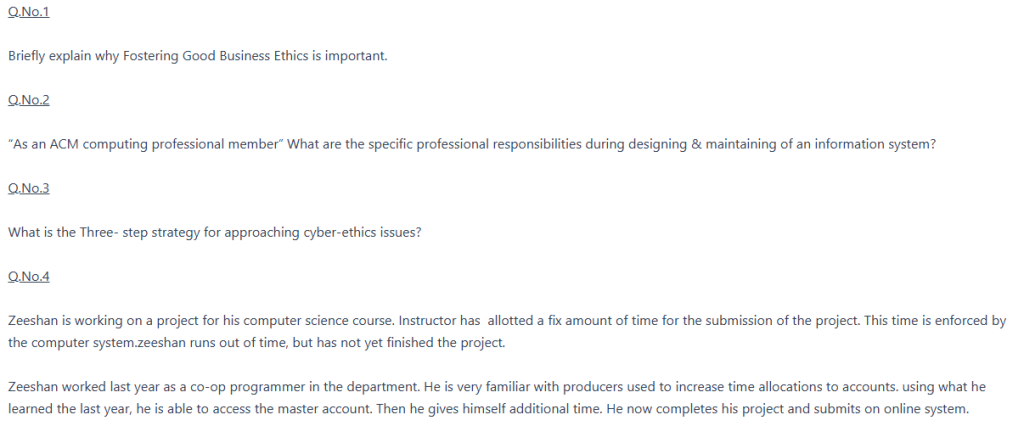
Mid Term Examination 2021
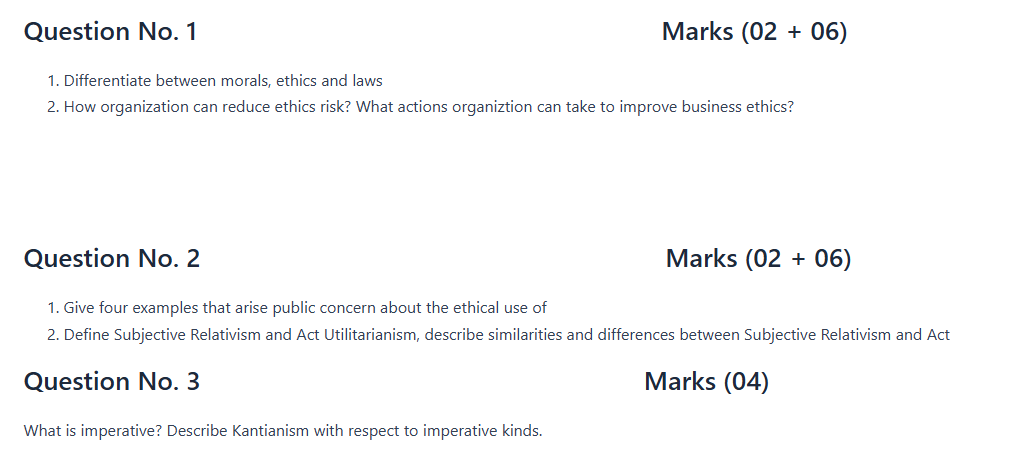
Sessional 1 question paper 2020
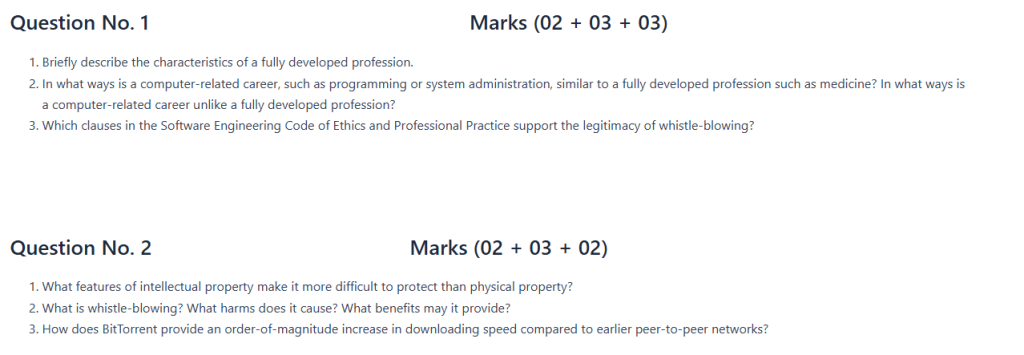
Sessional 2 question paper 2020
Mid term Paper 2022
Question No. 1
Shortly describe the following. Marks (06 * 02)
- What are the relative advantages and disadvantages of patents versus trade secrets?
- Why is it important that some information be made available to everyone through public records?
- Should parents implant microchips in their children to make them easier to identify in case they are lost or kidnapped? Why or why not?
- Before offering a job candidate a position, some potential employers do a criminal background check of the What are the pros and cons of this policy?
- What is the difference between spyware and adware?
- What is the difference between a computer virus and a worm?
Question No. 2 Marks (05)
In the Software Engineering Code of Ethics and Professional Practice, identify five clauses that reflect a utilitarian ethical viewpoint and identify five clauses that reflect a Kantian viewpoint.
Question No. 3
Briefly answer the following. Marks (04 * 03)
- Describe three “low-tech” methods that hackers have used to obtain login names and
- Explain the difference between an opt-in policy and an opt-out policy regarding information Which policy is favoured by privacy advocates?
- Suppose company A wants to develop a program that duplicates the functionality of a program made by company Describe how company A may do this without violating the copyrights held by company B.
- Explain two different ways a vote thief could cast multiple votes in an online
Question No. 4 Marks (06)
The following principal reasons have been given for the failure of computerized systems: a). A system designed for one purpose was used for another purpose.
- Software was reused without adequate
- There was an error in storing or converting a data d). A line of code became a single point of failure.
- The overall system was too complicated to
- There was another software error (other than those listed in a–e).
For each of the following systems, select the principal reason or reasons why it failed to operate as specified.
- Patriot missile
- Ariane 5
- AT&T long-distance network
- Denver International Airport baggage system
- Tokyo Stock Exchange
- Direct-recording electronic voting machines
Sessional 1 paper 2019
Important Note: Attempt all questions All Questions Carry Equal Marks.
Elaborate your answer with simple suitable examples, where Applicable
Question 1)
What is “Spam” & “Spam Epidemic? Why Spam is considered unethical? Explain with logic?
Question 2)
Enlist & explain the ways that do we use to interact with others over internet?
Question 3)
What is the Censorship? What new challenges, Internet has posed on Censorship?
Question 4)
What are the Characteristics of a Profession? Explain the Principles of Software Engineering code of Ethics”?