If Data Structures is the how of computing, Discrete Structures is the why behind it all. This isn’t just another math class—it’s the secret language of computer science, the rigorous logic that underpins everything from cryptography to algorithm design. And this past paper? It’s your decoder ring.
Let’s be clear: Discrete Structures can feel abstract. One moment you’re tracing logic proofs, the next you’re counting graph cycles or navigating modular arithmetic. This exam bridges that gap between pure theory and computational thinking.
What This Paper Really Tests:
1. Logical Foundation – Propositional and predicate logic questions aren’t just about truth tables; they’re about training your brain to structure unambiguous arguments—a skill that translates directly to writing bug-free conditions in code.
2. Proof Techniques – Direct, contradiction, induction. The paper doesn’t just ask you to use these methods; it reveals which type fits which problem. Induction, in particular, appears constantly—because it’s essentially the mathematical version of recursion.
3. Structures That Actually Matter –
- Set Theory & Functions: The bedrock of database queries and type systems.
- Combinatorics: Not just “how many ways?” but efficient counting—essential for algorithm analysis and probability.
- Graph Theory: From social networks to routing protocols, you’ll identify connectivity, planarity, or shortest paths.
- Relations & Modular Arithmetic: The heart of hashing, cryptography, and equivalence in distributed systems.
The Paper’s Personality:
It often starts deceptively simple—a few definitions, a truth table—then gradually layers complexity. By the final section, you might be proving a property of integers modulo *n* or drawing a Hasse diagram for a partial order. The shift is intentional: it mimics how discrete concepts build upon each other in real CS applications.
Where Students Get Stuck:
The “proof” questions. Not because they’re impossibly hard, but because they require a different kind of writing—concise, rigorous, yet readable. This paper rewards clarity as much as correctness.
How to Approach This Paper for Maximum Benefit:
- Treat it like a puzzle book, not a textbook. Work through each problem methodically, but look for the pattern in what’s being asked. Discrete math is highly modular—master a few core techniques, and you can adapt them widely.
- Draw everything. Graphs, lattices, Venn diagrams—even if the question doesn’t explicitly ask for it. Visualizing the structure often reveals the solution.
- Practice writing proofs as explanations. Imagine you’re convincing a skeptical peer, not just pleasing an examiner. If your reasoning is coherent step-by-step, you’re already most of the way there.
This past paper is more than a revision tool—it’s a diagnostic. It shows you where your logical intuition is strong and where the gaps are. And in the world of computer science, that intuition is what turns a coder into an architect.
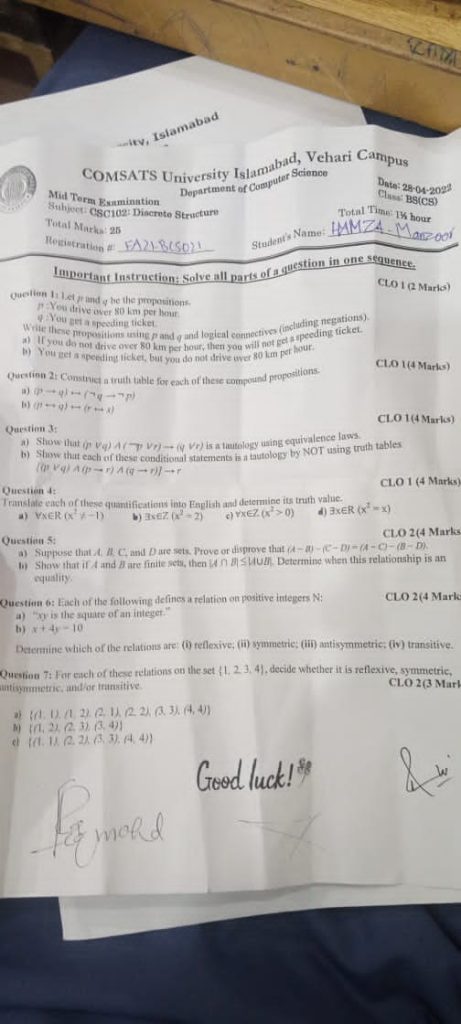
Discrete Structures Sp22 Mid term paper
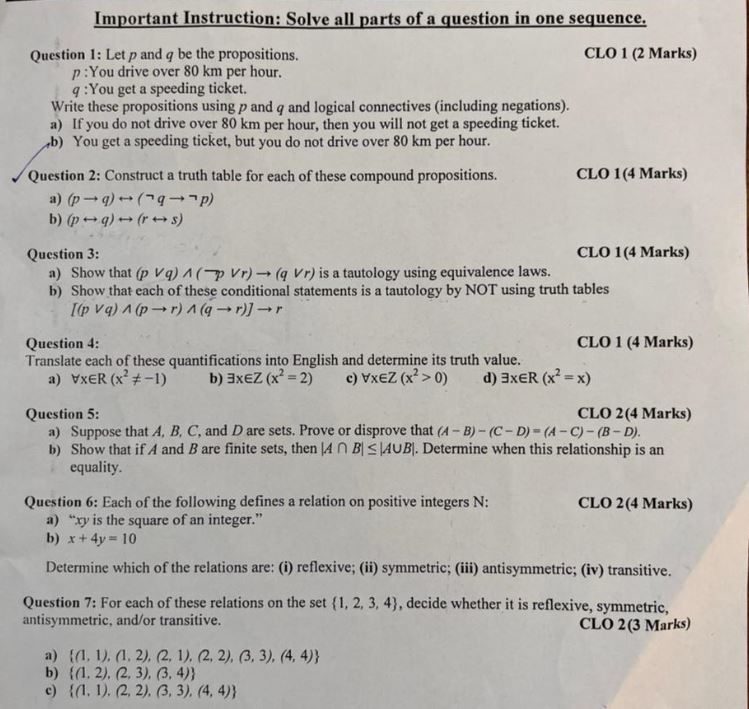
Midterm Exam 2021
Q1: Write down what it means for a relation to be transitive. Let A be the set{1,2,3} and the following relations are subsets of A x A. Which of the relations below are transitive? Give justification
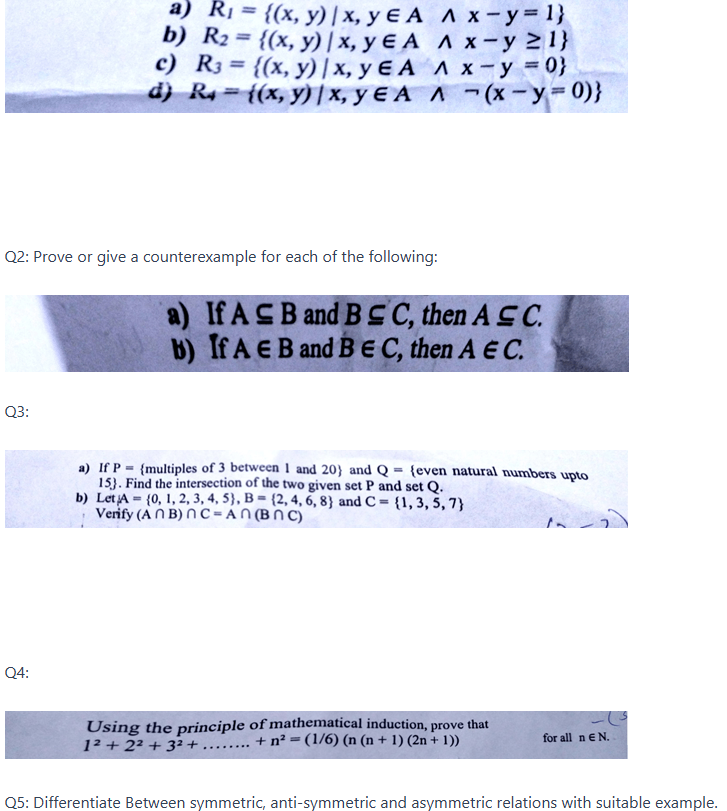
Sessional 2 2020
Q 01: Fing the argument form for the following argument and determine whether it is valid Can we conclude that the conclusion is true if the premises are sure?
If Socrates is human, then Socrates is mortal. Socrates is human Socrates is mortal. (3)
Also verify the argument by using the truth table.
Q #02: Show, that the hypotheses “it is not sunny this afternoon and it is colder than yesterday.” we will go swimming only if it is sunny,” “if we donot go swimming then we will take a canoe trip” and “if we take a canoe trip the we will be home by sunset” leads to the conclusion “we will be home by sunset”. (3)
Q:#03:
- a) Check whether the following expressions are functions 1) Rx)=1/x 2) Rx)=x 3) f(x)=(x² + 1)¹²
- b) Determine whether each of these functions is a bijection from R to R. 1) f(x)=2x+1 2) f(x)=x²+1
c) Classify the functions given below whether these are one to one or ont or both

Q 04: Let A- (1, 2, 3, 4, 5), B- (5.6, 7) and C-(a, b) a) Find all the subsets of C.
- b) Find the power set of A.
- c) Whether A, B and C are disjoint sets? d) What is the cardinality of AUBUC
- e) What is the cardinality of A-B
Final paper 2020
Qno.1:
A Construct the truth table of the compound proposition (PQ) — (P/Q) h Let P and Q be the Propositions where P: it is below freezing and Q: It is snowing, write the propositions using P. Q and logical
1) It is below freezing and snowing. connectives
2) It is below freezing but not snowing. 3) It is not below freezing and it is not snowing.
4) If it is below freezing, it is also snowing.
5) It is either below freezing or it is snowing, but it is not snowing if it is below freezing State which rule of inference is used in this argument if it rains today then we will not have a barbecue today. If we do not have a barbecue today then we will have a barbecue tomorrow. Therefore it it rains today then we will have a barbecue tomorrow. d) Use rule of inference to show that the hypotheses “Randy works hard” “If randy works hard, then he is a dull boy” and “If Randy is a dull boy, then he will not get a job” imply the conclusion “Randy will not get the job”.
1 102 10
#02: 10 Marks192679
- a) Determine whether is a function from to Rif 1) f(n)-1/n. 2) f(n) +(²+1)
3) f(n) 1/(n²-4)
- b) what is the value of 1-1
- c) By using Mathematical induction show that if n is a positive integer then
1+2++n=”2
Q03: 12 Marks(8+4)
- A) Describe an algorithm for the multiplication of two matrices of arbitrary order. b) Discuss the time complexity of linear search algorithm.
#104: 5 Marks(2+3)
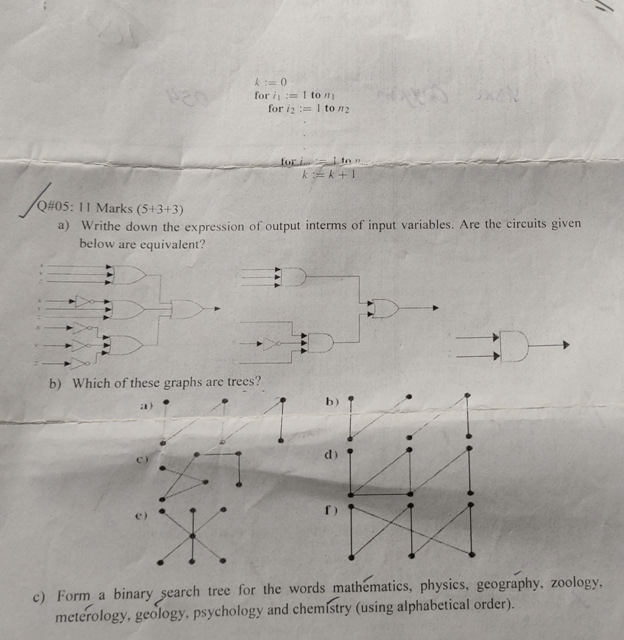
- The chain of an auditorium are tobe laheled with a letter and a positive integer not exceeding 100. What is the largest number of chairs that can be labeled differently? b) What is the value of K after the following code has been executed? Code on the next page.
Sessional 1 2020
Q NO 1:
(a) Define set equality, reflexive relation, function, statement, rule and argument.
(b) Construct the truth table for the An (BUC)=(ANB)U(ANC) to convert into logical form.
Q NO 2:
(a) Prove that (An B) = AC U B through venn diagram, if set A is subset of set 8.
(b) Use truth table to determine the argument form
p–>q
p–>r
p^q
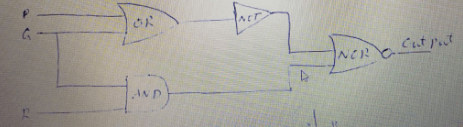
(c) Indicate all ouputs of a circuit given below using all possible input signals.
Sessional 2 2020