Let’s illuminate the truth: Electricity, Magnetism, and Optics are not three separate subjects. They are chapters in a single, profound story—the story of the electromagnetic force, which is the fundamental engine of every computer, every communication signal, and every sensor you will ever design. This past paper is your map to the invisible world. It tests whether you can see beyond the screen and the wire to the fields, waves, and photons that make information technology possible.
Forget dry equations about point charges and bar magnets. This is about understanding how a GPU renders light, how RAM stores bits, and how a fiber optic cable carries a continent’s worth of data in a glass thread thinner than a hair.
What This Paper Actually Illuminates: Your Mastery of the EM Spectrum
1. The Foundation: Fields – The Reality Between the Wires
The journey begins by ditching the idea that circuits are just about electrons in wires. You enter the world of fields.
- Electric Fields (E): The reason a transistor can be switched with a voltage. You’ll calculate fields from charge distributions (Gauss’s Law) and understand their role in capacitors—the fundamental component for memory (DRAM) and timing.
- Magnetic Fields (B): Not just for magnets. You’ll learn how moving charges (currents) create them (Biot-Savart Law, Ampère’s Law). This is the principle behind every hard disk drive (writing data by magnetizing a surface) and every electric motor in a cooling fan.
- Maxwell’s Revelation: The Unification. This is the pivotal moment. You’ll see how Faraday’s Law (a changing B-field creates an E-field) and Ampère-Maxwell’s Law (a changing E-field creates a B-field) form a self-sustaining loop. This is the genesis of light itself.
2. The Dynamic Reality: Electromagnetic Waves
When electric and magnetic fields oscillate together, they propagate through space as an Electromagnetic Wave.
- Wave Propagation: You’ll characterize waves by frequency (f) and wavelength (λ), understanding the spectrum from radio waves to gamma rays.
- The Speed of Light (c): Derived from fundamental constants (
c = 1/√(με)). This isn’t just a fact; it’s the ultimate speed limit for information and the synchronizing clock for all digital circuits (signal propagation delay on a chip is a direct consequence). - Poynting Vector (S): This tells you the direction and magnitude of EM energy flow. It’s how you quantify the signal strength from a WiFi router or the power in a laser beam.
3. The Applied Domains: Where Theory Becomes Technology
A. Circuit Theory as a Special Case: You’ll revisit circuits, now understanding them as quasi-static approximations of Maxwell’s equations. You’ll analyze AC circuits with inductors and capacitors, calculating impedance and resonance—the basis of all filtering, tuning, and power regulation in electronics.
B. Optics: Light as an EM Wave
This is where light stops being “just light” and becomes a precise engineering tool.
- Geometrical Optics: Lenses, mirrors, and imaging. The physics behind cameras, displays, and optical sensors.
- Wave Optics: Interference and diffraction. You’ll use these to explain the limit of optical microscope resolution, the working of anti-reflection coatings on lenses, and the operation of a CD/DVD (data read by laser interference).
- Polarization: The orientation of the E-field. Used in LCD screens to control pixels and in optical fibers to maintain signal integrity.
C. Modern Photonics & Communication
- Fiber Optics: Applying total internal reflection and understanding attenuation and dispersion—the key challenges in long-distance data transmission.
- Lasers: Stimulated emission producing coherent, monochromatic light. The indispensable tool for fiber optic transmitters, barcode scanners, and precision manufacturing.
4. The CS/IT Connection: The Physics of Information
This is the crucial synthesis. The paper will test your ability to connect EM principles to computing:
- How does a logic gate work? The controlled manipulation of electric fields in a semiconductor (transistor).
- How is data stored? Electrically in RAM (capacitors), magnetically on a hard drive (alignment of magnetic domains), or optically on a Blu-ray (pits burned by a laser).
- How do computers talk? Through guided EM waves in cables (coaxial, twisted pair) or unguided EM waves in the air (WiFi, Bluetooth).
The Paper’s Ultimate Challenge: Integrated Problem-Solving
The hardest questions won’t say “do this calculation.” They will present a technology scenario:
“A satellite transmits a 10 GHz microwave signal to Earth. Calculate the wavelength. If the transmitting antenna is 1m in diameter, estimate the beam divergence due to diffraction. Discuss how atmospheric absorption might affect the signal, and explain why optical (laser) communication might be considered as an alternative, citing two key physical advantages and one challenge.”
This demands mastery of concepts across electricity, magnetism, and optics, applied to a real-world trade-off analysis.
How to Conquer This Past Paper:
- Think in Fields. Visualize the electric field lines around a charged wire, the magnetic field circles around a current, and the self-propagating EM wave. This spatial intuition is critical.
- Follow the Energy. In any system, trace the energy from its source (e.g., battery), through its conversions (chemical → electrical → EM radiation → thermal loss), to its destination. The Poynting Vector is your guide.
- Master the Spectrum. Create a mental map of the EM spectrum with frequency/wavelength, technological applications (radio, microwave, IR, visible, UV, X-ray), and associated photon energies.
- Practice “Back-of-the-Envelope” Calculations. Quickly estimate orders of magnitude: the E-field near a power line, the B-field from a CPU’s current, the wavelength of a mobile phone signal.
- Connect Every Concept to a Device. Don’t learn capacitance; learn “capacitors are used for RAM and power smoothing because…” This makes abstract theory concrete and memorable.
This past paper is your diploma in the physical layer of computing. It proves you understand that every bit is a charge, every signal is a wave, and every connection is mediated by the grand, unified theory of electromagnetism. Passing it means you see the invisible architecture upon which the entire digital age is built.
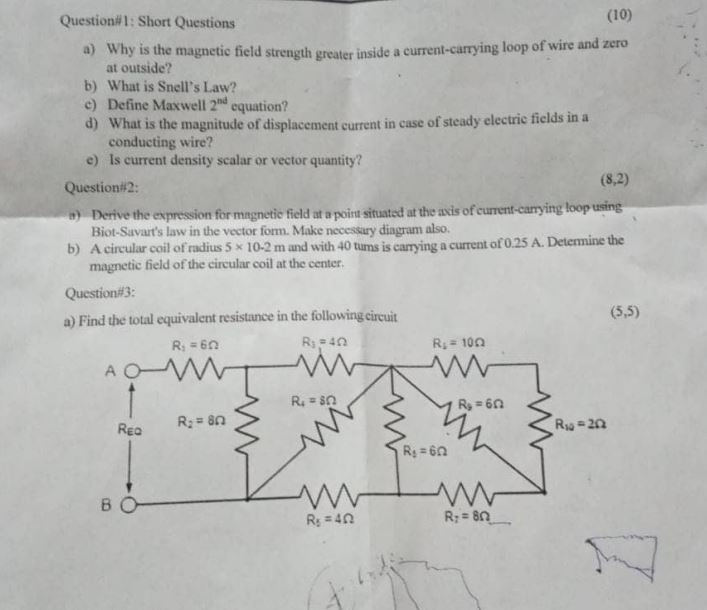
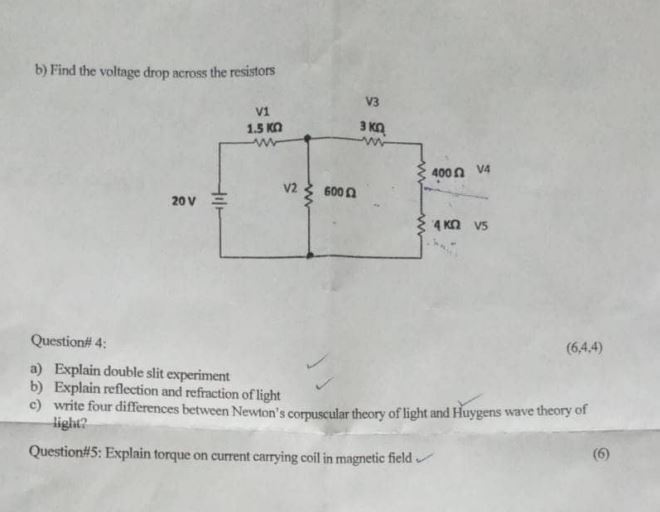
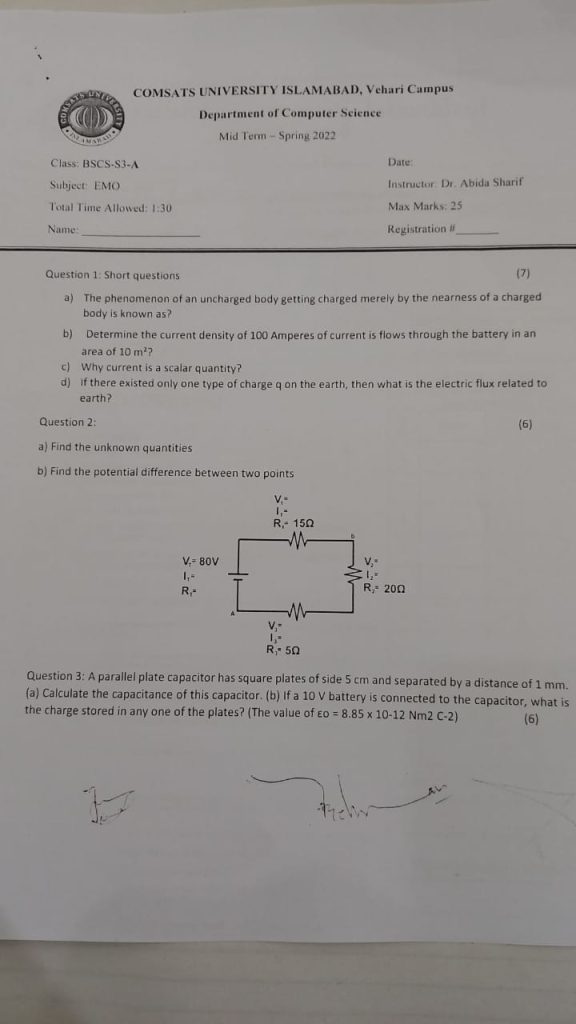
Electricity magnetism and optics all previous/ past question papers
Q1:
Find Electric Field due to dipole?
Q2:
How much electronic charge required to make 1 coulomb?
Q3:
The distance between two parallel wires carrying currents of 10 A and 20 A is 10 cm. Determine the magnitude and direction of the magnetic force acting on the length of 1 m of wires, if the currents are carried in the opposite direction?
Q4:
Find potential due to a point charge?