Let’s ground this in reality: Applied Physics is where the elegant laws of the universe stop being equations on a chalkboard and start becoming the engine of technology. This isn’t “physics-lite”—it’s the rigorous, often messy, process of taking principles from electromagnetism, thermodynamics, and quantum mechanics and forging them into semiconductors, lasers, sensors, and circuits. This past paper is your test of translation: can you take the raw science and apply it to build, explain, or troubleshoot something real?
Forget purely theoretical derivations. This is about knowing why a transistor switches, how an optical fiber carries data, or what limits the speed of a microprocessor. It’s the foundational science behind every piece of hardware you will ever use.
What This Paper Actually Builds: Your Engineering Physics Intuition
1. The Core Pillars: Physics as a Toolkit
The paper tests your ability to wield key physics domains as tools for technological problems.
A. Electromagnetism: The Backbone of Modern Tech
This isn’t just about Coulomb’s Law; it’s about application.
- Circuits & Electronics: Moving from ideal resistors to real-world RC, RL, and RLC circuits. Analyzing transients and time constants—crucial for signal processing and digital clock design.
- Semiconductor Physics: The heart of computing. You’ll explain p-n junction behavior, diode rectification, and the basic operation of a BJT or MOSFET transistor as a switch or amplifier. This bridges solid-state physics to logic gates.
- Electromagnetic Waves & Optics: How microwaves heat food, how antennas transmit WiFi signals, and the principles of fiber-optic communication (total internal reflection, attenuation).
B. Modern Physics: The Science of the Very Small & Very Fast
- Quantum Mechanics Applied: Not solving the Schrödinger equation, but using its consequences: the photoelectric effect (solar cells, photodetectors), wave-particle duality (electron microscopy), and quantum tunneling (the basis of flash memory and scanning tunneling microscopes).
- Solid-State Physics: Connecting crystal lattice structures to material properties (conductors, semiconductors, insulators) and explaining phenomena like superconductivity.
C. Mechanics & Thermodynamics for Devices
- Materials & Stress-Strain: Why do we use silicon for chips and aluminum for heat sinks? Selecting materials based on Young’s modulus, thermal conductivity, and expansion coefficients.
- Thermodynamics in Systems: Heat dissipation in processors, efficiency of cooling systems (fans, heat pipes), and the principles behind refrigeration cycles.
2. The Applied Mindset: From Equation to Specification
The key shift is toward quantitative reasoning for design and analysis.
- You will be given a sensor spec (e.g., a thermistor’s resistance-temperature curve) and asked to design a simple circuit to convert its output to a voltage for an ADC.
- You will calculate the power dissipation in a resistor network or the heat load on a chip package.
- You will estimate the bandwidth limit of a coaxial cable given its capacitance and inductance per unit length.
3. The Laboratory Connection: Measurement and Error
Applied Physics is grounded in experiment. The paper often incorporates:
- Instrumentation: Understanding how measuring devices work (oscilloscopes, multimeters, spectrometers) and their limitations (bandwidth, impedance loading, resolution).
- Error Analysis & Significant Figures: Propagating uncertainties in measurements to determine the reliability of a calculated result (e.g., the resistivity of a wire). This is the ethics of engineering data.
4. Interdisciplinary Synthesis: The Physics of Systems
The hardest questions don’t isolate topics. They present a system:
“A solar-powered wireless sensor node consists of a photovoltaic cell, a battery, a microcontroller, and a radio transmitter. Discuss the key physics principles at each stage: energy conversion (photovoltaic effect), energy storage (electrochemistry), heat generation (Joule heating in the MCU), and signal propagation (EM waves). Estimate the system’s operational lifetime given sunlight data and power draws.”
This tests your ability to see physics as an integrated whole within an engineered device.
The Paper’s Real Challenge: Dimensional Analysis and Estimation (Fermi Problems)
A classic applied physics skill is order-of-magnitude estimation. You might be asked:
“Estimate the number of electrons flowing per second through the filament of a 60W light bulb.” or “Estimate the magnetic field strength at the surface of a hard disk drive’s read head.”
This tests fundamental understanding, unit manipulation, and practical intuition more than rote memorization.
How to Conquer This Past Paper:
- Focus on Mechanisms, Not Just Formulas. Don’t just memorize
V=IR. Understand why resistance exists (electron scattering in a lattice) and how it changes with temperature for a metal vs. a semiconductor. - Build a Mental Library of Constants & Orders of Magnitude. Know typical voltages (µV in sensors, mV in nerves, V in logic, kV in power lines), currents (nA in ICs, mA in LEDs, A in motors), and sizes (nm for transistors, µm for optical fibers, cm for chips).
- Practice “Sketch and Explain” For any device (laser, transistor, motor), be able to draw a simple labeled diagram and explain its operating principle step-by-step using physics concepts.
- Follow the Energy. In any system, trace the energy from its source, through its conversions (electrical to thermal, light to electrical), to its final form (waste heat, signal, motion). This is a powerful unifying approach.
- Connect to Your CS/Engineering World. Constantly ask: “What is the physics behind this?” The clock speed limit? Heat dissipation and signal propagation delay. Cloud storage? Magnetic domain flipping on hard disks or charge trapping in SSDs.
This past paper is your proof of technological literacy. It certifies that you understand the physical principles that constrain, enable, and define the hardware that runs your software. Passing it means you are not just a user or a programmer of technology—you are an informed engineer who understands its material soul.
Applied Physics for engineer all previous/ past question papers
Q1:
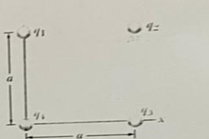
In Fig. the four particles form a square of edge length a = 5.00 cm and have charges q1 = +10.0nC, q2 = -20.0nC, q3 = +20.0nC and q4 = -10.0nC. In unit-vector notation. What net electric field do the particles produce at the square’s center?
Q2:
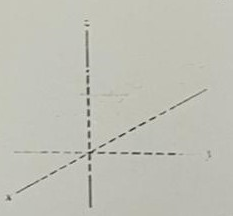
An electric field given by E’ = 4.0i^ – 3.0(y2 + 2.0) j^ pierces a Gaussian cube of edge length 2.0 m and positioned as shown in Fig 23-7. (The magnitude E is in newtons per coulomb and the position x is in meters). What is the Electric Flux through the (a) top face (b) bottom face (c) left face and (d) back face? (e) What is the net electric flux through the cube?
Q3:
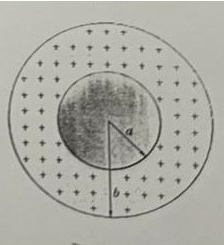
Figure shows a spherical shell with uniform volume charge density p= 1.84 nC/m3. Inner radius a= 10.0 cm and outer radius b= 2.00a. What is the magnetic of the electric field at a radical distances (a) r=0; (b) r=a/2.00; (c) r=a; (d) r= 1.50a; (e) r= b; and (f) r= 3.00b?
Applied Physics Sessional 2
Q1:
a) Define projectile motion with example and prove that R= (v./g)sin20.
b) Ifa-b-2c, a+b-= 4c and c-3i+4j, then what are vector a and b? (*+2)
Q2:
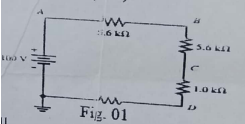
Determine the voltage at each point with respect to ground in figure 01 and each resistor have 20 volts across it.
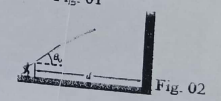
You throw a ball toward a wall at speed of 25.0 m/s and
angle is 0 = 40° above the horizontal as shown in figure 2
The wall distance d-22 m from the release point of the ball
How far above the release point does the ball hit the wall?
What are the horizontal and vertical componens of the
velocity as it hits the wall?
Question 03
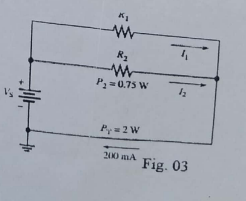
Find the unspecified quantities mentioned in the figure 03.
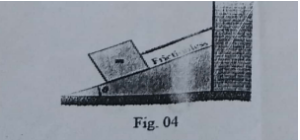
In figure 04 below, let the mass of the block be 8. 5 Kg and the
angle be 30°
1.Tension of the cord
- Normal force acting on the block.
Q4: The position of the particle moves along the x axis is given by r = 9.75-1.5r , Find average
velocity and acceleration at t-3s and + = 5$
b) if B is added to A, the result is 6î +1}. If Bis subtracted from A, the result is -4} +77
What is the magnitude of À?
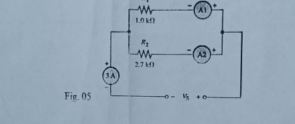
©) How much branch current should cach meter reads in figure 05?