
Data Structures and Algorithms is the mountain every CS student must climb. It’s not just a subject; it’s the foundation of how you think as a programmer. And this past paper? It’s your training ground.
This exam isn’t about memorizing syntax or definitions. It’s about problem-solving under pressure—the same skill you’ll use in coding interviews, competitive programming, and real-world software design. The paper typically splits into two distinct mindsets: theory and application.
The Theory Side tests your understanding of why things work. Expect questions on:
- Time and space complexity analysis—not just stating Big-O, but deriving it from pseudocode.
- Comparisons: “When would you use a hash table vs. a binary search tree?”
- Trade-offs: “Explain the advantage of a B-tree over an AVL tree for database indexing.”
The Application Side is where your logic meets the keyboard. You’ll face:
- Step-by-step tracing: “Show the steps of quicksort on this array.”
- Algorithm design: “Write an algorithm to detect a cycle in a directed graph.”
- Data structure implementation: “Write pseudocode to insert a node in a red-black tree.”
What makes this paper particularly revealing is how it mirrors industry expectations. The problems are rarely abstract—they’re framed in scenarios like social network connections (graphs), dictionary autocomplete (tries), or cache simulation (heaps).
The Hidden Challenge: Time management. Many students report the paper is long—not necessarily difficult, but dense. You’ll need to decide quickly whether to sketch a solution briefly or dive deep into implementation.
How to Use This Paper Effectively:
- First pass without time limits—understand every question deeply.
- Second pass under exam conditions—practice prioritizing problems based on your strengths.
- Third pass for optimization—refine your explanations and pseudocode clarity.
Remember: The examiner isn’t just looking for correct answers, but for clear, efficient, and well-reasoned solutions. Your ability to communicate your thought process matters as much as the algorithm itself.
This paper serves as both an assessment and a mirror—showing you exactly where your logical muscles are strong and where they need more repetition. Master it, and you’re not just preparing for an exam; you’re building the core skill set of your career.
Data structure and algorithm Final in 2021
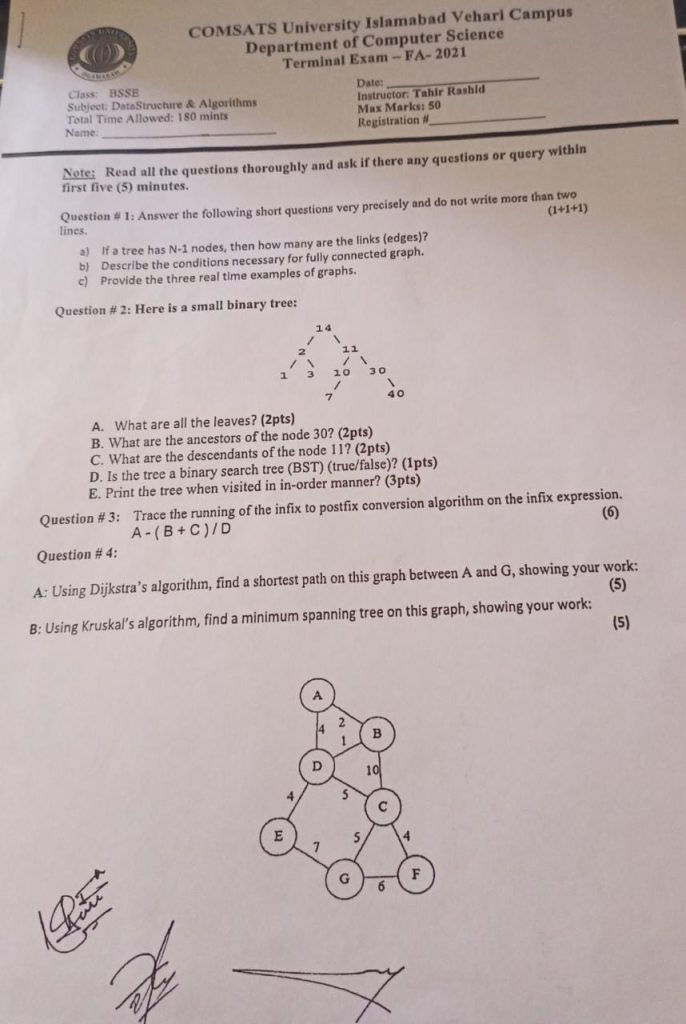

Mid term Exam Data structure and algorithm paper in 2021
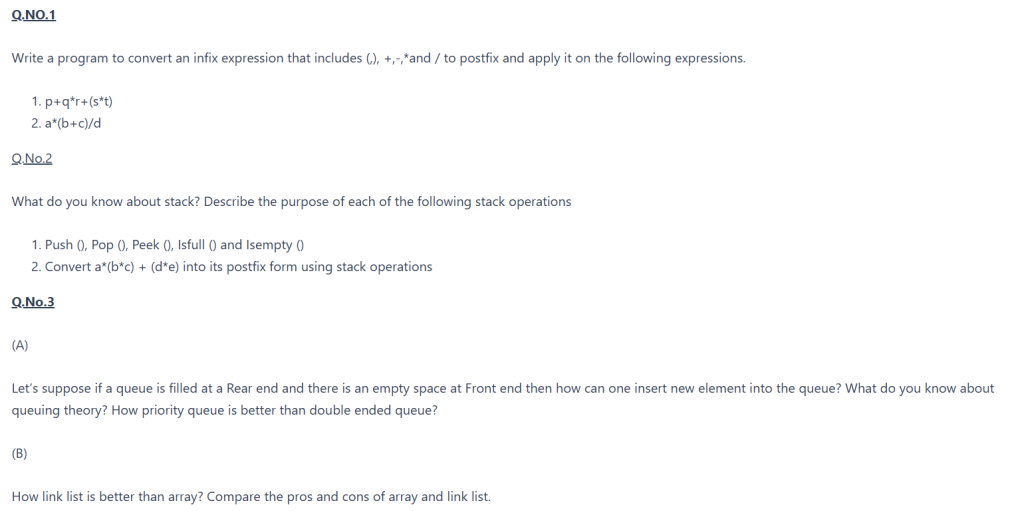
Data structure and algorithm Sessional I in 2020
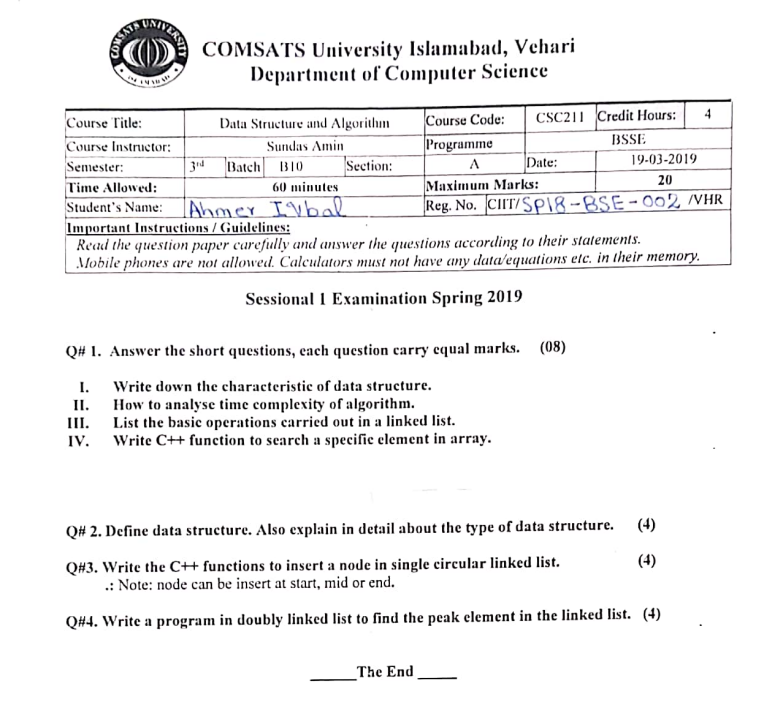
Data structure and algorithm Sessional II in 2020
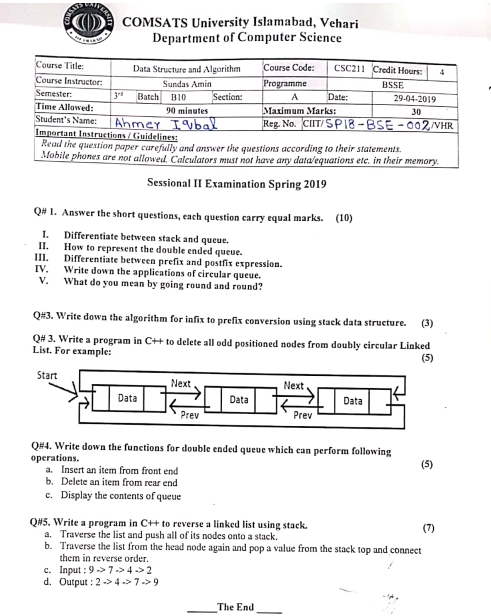
Data structure and algorithm Final in 2020
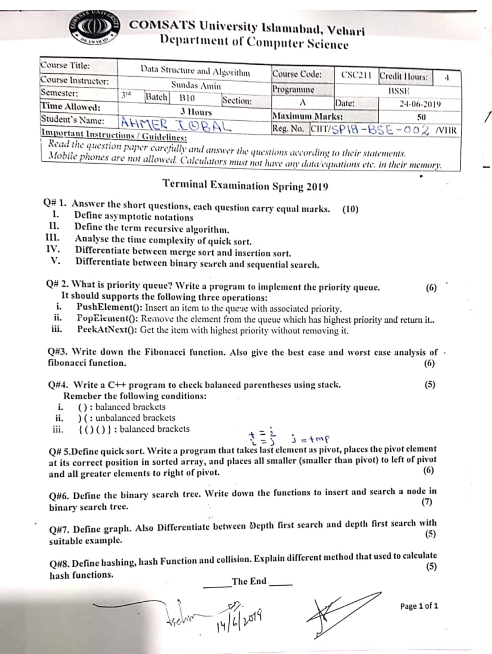
Data structure and algorithm Sessional II in 2019
Q1: Write a program to convert an infix expression that includes (.)- *and la positia on the following expressions.
P+q*r+(s*t)
a*(b+c)/d
Q2: What do you know about stack? Describe the purpose of each of the following stack operations (I) Push () (II) Pop () (III) Peek () (iv) Isfull ( ) (v) Isempty () (in Convert a* (b*e) + (d*e) into its postfix form using stack operations.
Q3:Lets suppose if a queue is tilled at Rear end and there is an empty space at Front end then how can one insert new element into the queue? What do you know about queuing theory? How priority queue ? better than double ended queue?
Q3:How Tint list is better than Array? Compare the pros and cons of array and link list.