Let’s dispel the Hollywood myth right now: Artificial Intelligence (AI) is not about building conscious androids. It’s the rigorous, often gritty, engineering discipline of creating systems that can perceive, reason, learn, and act to achieve specific goals. This past paper isn’t a sci-fi quiz; it’s a demanding test of your ability to model intelligence as a computational process—one filled with trade-offs, approximations, and fundamental philosophical limits.
Forget magic. This is about search, probability, optimization, and data. It’s the ultimate synthesis of computer science, mathematics, and cognitive science.
What This Paper Actually Measures: Your Mastery of Intelligent System Design
1. The Philosophical & Historical Foundation: What is Intelligence?
The opening questions frame the entire field. You must articulate:
- The Turing Test and its critiques (the Chinese Room argument).
- Defining AI: The distinction between Acting Humanly (Turing Test) and Acting Rationally (the focus of modern AI). The shift from trying to simulate human thought to engineering rational agents.
- AI’s Scope: From Weak/Narrow AI (excelling at a specific task like chess or image recognition) to the theoretical Strong/General AI (human-level, cross-domain intelligence).
2. The Core Paradigms: How to Engineer “Thinking”
The paper tests your fluency in the major schools of thought for creating intelligent behavior.
A. The Symbolic Approach: Thinking with Logic & Rules
- Knowledge Representation: Using propositional logic, first-order logic, and ontologies to encode facts about the world (e.g., “All humans are mortal. Socrates is a human.”).
- Reasoning & Inference: Applying deduction to derive new knowledge. You’ll use resolution or forward/backward chaining in a rule-based system.
- Limitations: The knowledge acquisition bottleneck and the difficulty of handling uncertainty. This leads to…
B. The Stochastic Approach: Thinking with Probability & Belief
Since the real world is uncertain, rational agents must handle it.
- Bayesian Networks: The cornerstone. You’ll construct a simple network, encode conditional independence assumptions, and perform inference (compute
P(Cause | Evidence)) using concepts like Bayes’ Theorem. - Markov Models & Hidden Markov Models (HMMs): For modeling time-series data (like speech recognition or robot localization). You’ll understand the tasks of evaluation, decoding (Viterbi algorithm), and learning.
C. The Connectionist Approach: Thinking with Learning from Data
Modern AI is dominated by this paradigm.
- Neural Networks (NNs): From biological inspiration to mathematical function approximators. You’ll diagram a simple feedforward network, understand activation functions (sigmoid, ReLU), and describe the backpropagation algorithm for learning weights.
- Deep Learning: The power of hierarchical feature learning in Convolutional Neural Networks (CNNs) for vision and Recurrent Neural Networks (RNNs/LSTMs) for sequence data. You’ll explain their architectures and why they work.
D. The Action-Oriented Approach: Thinking with Goals & Actions
- Search: Foundational. You’ll apply and compare uninformed search (BFS, DFS, UCS) and informed search (A* with a heuristic) to problems like pathfinding or puzzles. You’ll prove properties like admissibility and consistency of heuristics.
- Planning: Representing states, actions, and goals to sequence actions (STRIPS representation). You may contrast classical planning with real-world challenges requiring probabilistic planning (Markov Decision Processes – MDPs).
3. Core Subfields & Applications
You’ll need to connect theory to concrete domains:
- Computer Vision: From edge detection to object classification with CNNs.
- Natural Language Processing (NLP): From n-gram models and TF-IDF to modern transformers and attention mechanisms.
- Machine Learning: The overarching field. Distinguishing supervised (classification, regression), unsupervised (clustering, dimensionality reduction), and reinforcement learning (an agent learning from rewards/punishments).
- Robotics: The perception-planning-action loop, often integrated with techniques like SLAM (Simultaneous Localization and Mapping).
4. The Critical Lens: Ethics & Limitations
Modern AI papers demand you grapple with the consequences.
- Bias & Fairness: How biases in training data lead to discriminatory models.
- Explainability (XAI): The “black box” problem of deep learning and the need for interpretable AI.
- Safety & Alignment: Ensuring AI systems do what we intend, especially as they become more capable.
The Paper’s Ultimate Challenge: Synthesis and Trade-off Analysis
The hardest questions are design and analysis problems. For example:
“Design a system to filter spam emails. Justify your choice of a Naïve Bayes classifier over a rule-based system. Describe the features you would extract, and explain how you would handle the trade-off between precision and recall. Finally, discuss one major ethical consideration in deploying such a system.”
This requires you to blend algorithmic knowledge, practical implementation insight, and ethical reasoning.
How to Conquer This Past Paper:
- Think in Terms of Agents. For any problem, ask: What are the agent’s percepts, actions, and goals? What is its utility function? This frames all of AI.
- Master the Trade-offs. Know when to use a symbolic vs. a stochastic vs. a learning approach. Each has strengths: logic for precision, probability for uncertainty, learning for pattern-finding in data.
- Practice Drawing Diagrams. Draw Bayesian networks, neural network architectures, search trees, and state spaces. Visualizing the model is 90% of solving the problem.
- Understand the “Why” Behind the Math. Don’t just apply Bayes’ Theorem; understand it as a method for updating beliefs with evidence. Don’t just describe backpropagation; understand it as gradient descent in a high-dimensional space.
- Stay Grounded in Reality. Connect every concept to a real-world application. Search -> Google Maps. Bayesian Networks -> Medical Diagnosis. CNNs -> Face ID. This cements understanding.
This past paper is your initiation into one of the most transformative fields in human history. It proves you can move beyond using intelligent tools to understanding and constructing the principles behind them. Passing it means you are equipped not just to follow the AI revolution, but to help engineer it—thoughtfully and responsibly.
Artificial intelligence all previous/ past question papers
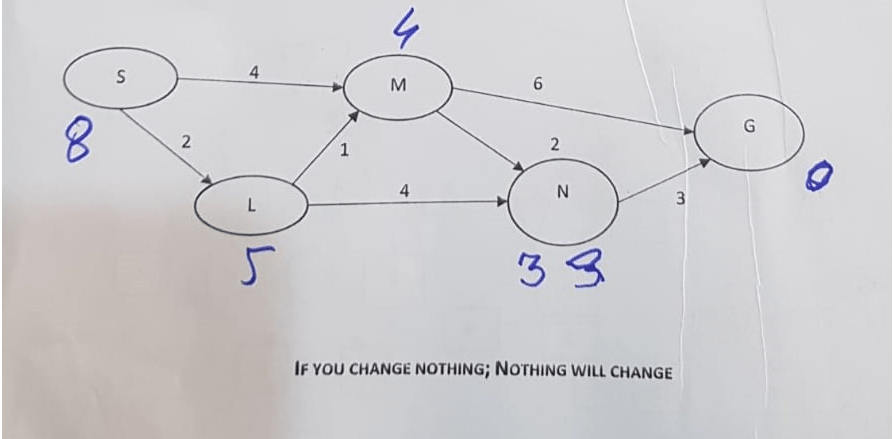
Q4: What paths and cost will be returned by 1-Uniform Cost Search And 2-A* Search
AI previous question papers Sessional 1 2020
Q1. Answer the following.
- Which agent makes its action better based on the feedback from critic element? (01)
- How does a learning agent “learn”? (01)
Q2. ANSWER THE QUESTIONS IN LIEU OF SEARCH PROBLEM GIVEN BELOW. IF YOU COME ACROSS ANY TIES BREAK THEM ALPHABETICALLY.
Artificial intelligence past question paper
- WHAT PATH WOULD BREADTH-FIRST GRAPH SEARCH WOULD RETURN?
- WHAT PATH WOULD DEPTH-FIRST GRAPH SEARCH WOULD RETURN?
- WHAT PATH WOULD UNIFORM COST GRAPH SEARCH WOULD RETURN?
- WHAT PATH WOULD A* SEARCH WOULD RETURN?
| STATE | S | L | M | N | O | G |
| HEURISTIC | 5 | 3 | 4 | 2 | 1 | 0 |
- CONSIDER THE FOLLOWING HEURISTICS
| STATE | S | L | M | N | O | G |
| H1 | 6 | 4 | 7 | 3 | 4 | 0 |
| H2 | 5 | 3 | 7 | 1 | 4 | 0 |
- IS H1 ADMISSIBLE AND CONSISTENT?
- IS H2 ADMISSIBLE AND CONSISTENT?
Q3. FOR 8-PUZZLE PROBLEM, WE WANT TO SEARCH FOR A SOLUTION USING A* SEARCH. STATE THE FOLLOWING. (05)
1- STATES 2- SUCCESSOR FUNCTION 3- GOAL TEST 4- STEP COST 5- PATH COST
Artificial intelligence previous question paper Sessional 2 2020
Map colouring
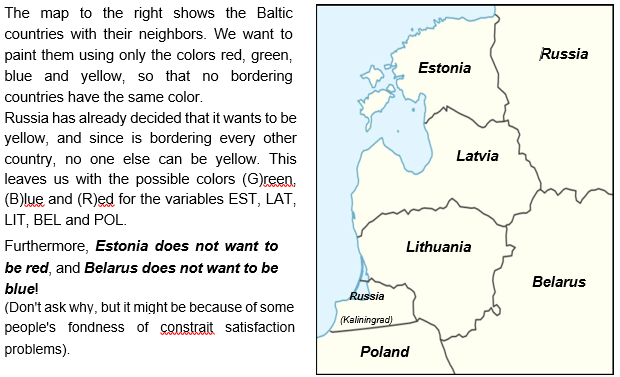
1. Formulate this problem as a CSP
| Draw the constraint graph below and write the constraints at the graph edges. |
| Enforce all unary constraints by reducing the initial domains. |
| Circle every graph node and write the resulting domain inside the circle. |
- Which variable should we choose next?
Now we want to color the rest of the countries using the backtracking algorithm. We need to select a variable which we can assign a value. Which one should we choose?
- Which variable(s) does the Minimum Remaining Values* heuristic suggest that you try next? (*i.e, choose the variable with the fewest legal values). Check all that apply:
- BEL ▢ EST ▢ LAT ▢ LIT ▢ POL
- Which variable(s) does the Degree Heuristic* suggest that you try next?
(*i.e, choose the variable with most constraints on remaining variables). Check all that apply:
- BEL ▢ EST ▢ LAT ▢ LIT ▢ POL
3. Make the graph arc consistent
Assume that we color Poland Green. What are the resulting domains after enforcing arc consistency on the graph?
Artificial intelligence previous final question Paper 2020
Q1. Consider the following Axioms. (18)
- 0 ≤ 5
- B ≤ C ( ≤ sign changes to ≥ if B > C)
- ∀ x x ≤ x
- ∀ x x ≤ x + 0
- ∀ x x + 0 ≤ x
- ∀ x, y x + y ≤ y + x
- ∀ x, y, z w ≤ y ⋀ x ≤ z ⟹ w + x ≤ y + z
- ∀ x, y, z x ≤ y ⋀ y ≤ z ⟹ x ≤ z
- Give a backward chaining proof of the sentence B ≤ 5 + C. Show only the steps that lead to success.
- Give a Forward chaining proof of the sentence B ≤ 5 + C. Show only the steps that lead to success.
NOTE: B and C are the two significant digits of your roll number i.e For roll no 023 [ 2 is B and 3 is C ]
Q2. CONSIDER A VOCABULARY WITH FOLLOWING SYMBOLS. (07)
OCCUPATION (P,O): PREDICATE. PERSON P HAS OCCUPATION O
CUSTOMER (P1, P2): PREDICATE. PERSON P1 IS A CUSTOMER OF PERSON P2
BOSS (P1 , P2 ): PREDICATE. PERSON P1 IS A BOSS OF PERSON P2
CONSTANTS DENOTING OCCUPATIONS: ARCHITECT, TEACHER, ACCOUNTANT, ARTIST
CONSTANTS DENOTING PEOPLE: SANA , JAMAL , SALEEM
USE THE SYMBOLS TO WRITE THE FOLLOWING STATEMENTS IN FIRST ORDER LOGIC.
- SANA IS EITHER AN ARCHITECT OR A TEACHER.
- JAMAL IS AN ARCHITECT AND HE HOLDS ANOTHER JOB.
- ALL TEACHERS ARE ARTIST.
- JAMAL HAS NO ACCOUNTANT (NOT A CUSTOMER).
- SALEEM HAS HIRED SERVICES OF ARCHITECT AND ARTIST. ( IS A BOSS)
- THERE EXIST AN ACCOUNTANT WHOSE CUSTOMERS ARE ALL TEACHERS.
- EVERY ARTIST HAS AN ACCOUNTANT.
Artificial intelligence past question paper Final 2022
Q1: IN TABLE GIVEN BELOW, FOR THE FOLLOWING TERMS ON LEFT CHOOSE THE CORRECT DEFINITION, YOU ONLY HAVE TO ANSWER 4 TERMS BASED ON LAST 2 DIGITS OF YOUR ROLL NO. (Choose two terms based on your last two digits of roll number and other two terms will be calculated according to the given formula (if digit is even, add 1 to
it, if digit is odd, subtract 1 into it. For example,
If your roll number is 03, the four terms you will answer for are 0 (Sound), 3 (Entailment), 0-1-1 (Term)
and 3-1-2 (Conjunctive Normal Form)ROLL NO TERMS 0 SOUND TERM CHOICES
DISJUNCTION OF LITERALS, AT MOST ONE OF WHICH IS POSITIVE
DESCRIBE A SENTENCE THAT IS TRUE IN SOME MODEL.
ASSOCIATES SYMBOLS WITH WORLD OBJECTS, RELATIONS, AND FUNCTIONS.
- CONJUNCTIVE
- NORMAL FORM
- ENTAILMENT
- SATISFIABLE
HORN CLAUSE
REPRESENTED AS A CANONICAL CONIUNCTION OF DISJUNCTIONS
DESCRIBE A SENTENCE THAT IS FALSE IN ALL MODELS. DEFINES TRUTH OF EACH SENTENCE WITH RESPECT TO EACH POSSIBLE WORLD
COMPLETE
CONSTRUCTED FROM SIMPLER SENTENCES, PARENTHESES, AND CONNECTORS. AN INFERENCE PROCEDURE THAT DERIVES ONLY ENTAILED SENTENCES.
SEMANTICS
SYNTAX
DESCRIBE A SENTENCE THAT IS TRUE DE ALL MODELS
AN INFERENCE PROCEDURE THAT DERVISALL ENTAILED SENTENCES.
CHAIN OF INFERENCE RULE CONCLUSIONS LEADING TO A DESIRED SENTENCE.
9
UNSATISFIABLE
10
AGENT
11 12
PROOF
VALID
A FIRST ORDER LOGIC EXPRESSION THAT REFERS 30) AN OBJECT. PERCEIVES ENVIRONMENT BY SENSORS, ACTS BY ACTUATORS.
SPECIFIES ALL THE SENTENCES IN THE LANGUAGE THAT ALF WELL FORMED.
13
INTERPRETATION
14
COMPLEX SENTENCES
THE IDEA THAT A SENTENCE FOLLU
TOUICALLY FROM HER SENTENCE.
Q2-USE THE SYMBOLS TO WRITE THE FOLLOWING STATEMENTS IN FIRST ORDER LOGIC. (0)
1. AYESHA PERFORMS ATHLETICS
2. ATTIA PROFESSION IS MEDICINE AND SHE SPENDS HER FREE TIME WATCHING MOVIES.
3. ALL STUDENTS WHO TAKE AI PASSES IT. 4. SOME STUDENTS WHO FAILED OID NOT STUDY.
5. NIMBA WANTED TO BE A BOLOGIST BUT SHE BECAME PHYSICIST.
6. FOR ALL STUDENTS WHO STUDY BIOLOGY, SOME BECOME DOCTORS AND SOME BECOME PHARMACIST
Q3-SOLVE THE FOLLOWING PROBLEM USING RESOLUTION INFERENCE RULE.(10)
EVERYONE WHO LOVES ALL ANIMALS IS LOVED BY SOMEONE, ANYONE WHO KILLS AN ANIMAL IS LOVED BY NO ONE. AC
LOVES ALL ANIMALS. EITHER ALL OR IFRAH KILLED THE CAT, WHO IS NAMED PLUTO. DIDIFRAH KILLED THE CAT?
Q4-CONSIDER A LOGICAL BASE FINANCIAL ADVISER. (20)
THE FUNCTION IS TO ADVISE A USER ABOUT WHETHER TO INVEST IN STOCKS OR SAVINGS. SOME INVESTORS MIGHT
WANT TO SPLIT THEIR MONEY, LET’S SAY THAT WE HAVE DETERMINED THE FOLLOWING RULES: 1.INDIVIDUALS WITH INADEQUATE SAVINGS SHOULD MAKE INCREASING SAVINGS THEIR TOP PRIORITY, REGARDLESS OF
INCOME
2. INDIVIDUALS WITH ADEQUATE SAVINGS AND ADEQUATE INCOME SHOULD CONSIDER STOCKS, WHICH ARE RISKIER
BUT POTENTIALLY MORE PROFIT.
3. INDIVIDUALS WITH A LOWER INCOME AND ALREADY HAVE ADEQUATE SAVINGS SHOULD SPLIT THEIR INCOME
BETWEEN SAVINGS AND STOCKS.
OUR RULE IS TO HAVE AT LEAST $5000 IN THE BANK FOR EACH DEPENDENT. AN ADEQUATE INCOME MUST BE STEADY AND SUPPLY AT LEAST $15000 PER YEAR PLUS $4000 FOR EACH DEPENDENT. LET’S START CODING UP SOME RULES:
SAVINGS ACCOUNT(INADEQUATE)→ INVESTMENT(SAVINGS). SAVINGS ACCOUNT(ADEQUATE) INCOME (ADEQUATE) INVESTMENT(STOCKS).
SAVINGS ACCOUNT(ADEQUATE) INCOME(INADEQUATE)→INVESTMENT COMBINATION).
1. YOU HAVE TO DEFINE RULES IN FOL FOR MINIMUM SAVINGS AND ADEQUACY OF SAVINGS. (5+5=10) 2- SOLVE THE FOLLOWING PROBLEM USING RULES GIVEN/DERIVED BY ABOVE INFORMATION. (5+5=10) JAMAL HAS FOUR DEPENDENTS, A STEADY INCOME OF $30,000 AND $15,000 IN HIS SAVING ACCOUNT. A)-SHOW THE ABOVE INFORMATION BY ADDING APPROPRIATE PREDICATES FROM EXAMPLE ABOVE. B)- DETERMINE HIS SUGGESTED INVESTMENT WITH THE HELP OF INFERENCE RULES.