Let’s settle this from the start: Discrete Mathematics is not math as you’ve known it. There’s no continuum, no smooth curves, no “solve for *x*.” This is the mathematics of separate, distinct objects. It is the bedrock upon which every algorithm, every cryptographic protocol, every database query, and every logical circuit is built. This past paper isn’t about calculation; it’s about proof, structure, and rigorous reasoning—the essential intellectual muscles for any computer scientist.
Forget about integrating functions. Here, you’re counting, proving, connecting, and logically deducing. It’s the science of the digital world itself.
What This Paper Actually Constructs: Your Logical Framework
1. The Language: Logic and Proof
This is the alphabet of discrete thought. You’ll be tested on fluency in translating between English, logic, and proof.
- Propositional & Predicate Logic: You won’t just know the symbols (¬, ∧, ∨, →, ∀, ∃). You’ll use them to formalize statements like “Every logged-in user has a unique session ID” and manipulate them using logical equivalences.
- Proof Techniques: This is the core skill. The paper demands you construct proofs, not just recognize them.
- Direct Proof: Building a logical chain from hypothesis to conclusion.
- Proof by Contraposition & Contradiction: The tools for proving statements like “If n² is even, then n is even.”
- Mathematical Induction: The signature method of computer science. You’ll use it not just for sums (like proving 1+2+…+n = n(n+1)/2) but for proving algorithm correctness (e.g., a sorting algorithm works for all lists of size *n*) and data structure properties (e.g., a heap has a certain height). You’ll master both simple and strong induction.
2. The Structures: Sets, Relations, and Functions
This is where you learn to model relationships formally.
- Set Theory: Operations (union, intersection, complement, Cartesian product) and proofs of set identities.
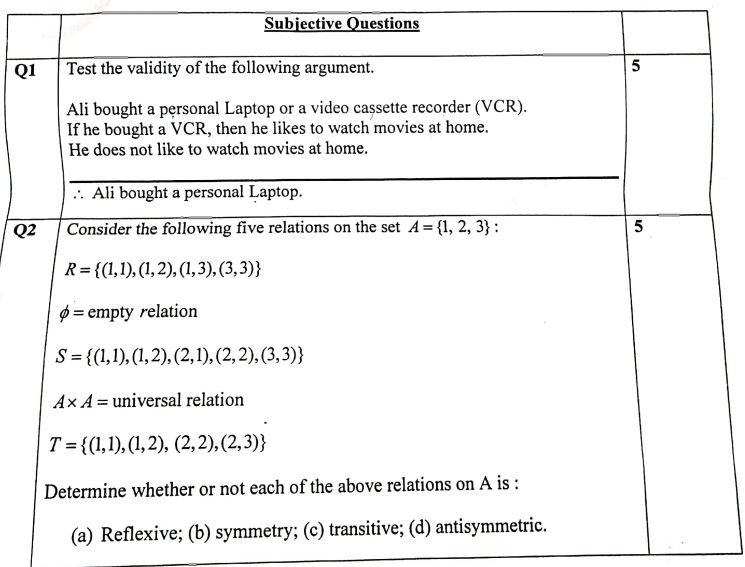
- Relations: Their properties (reflexive, symmetric, antisymmetric, transitive). You’ll classify relations, draw Hasse diagrams for partial orders, and identify equivalence relations (which partition sets, fundamental for modular arithmetic and hashing).
- Functions: Classifying them as injective (one-to-one), surjective (onto), bijective (perfect pairing). Understanding cardinality and what it means for two infinite sets to have the same size (like integers and rationals).
3. The Art of Counting: Combinatorics
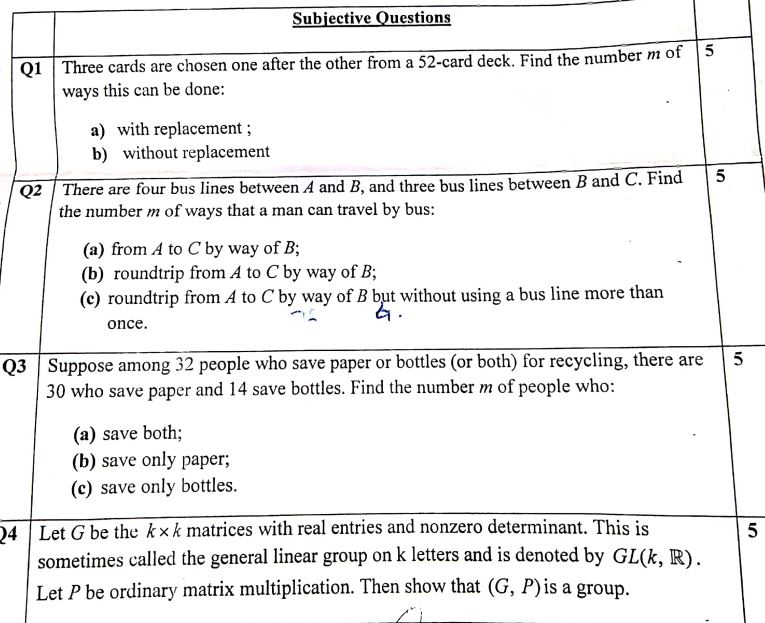
This is the mathematics of “how many ways?”—essential for analyzing algorithm complexity and probability.
- Sum & Product Rules: Foundational principles.
- Permutations & Combinations: Knowing when order matters (
P(n,r)) and when it doesn’t (C(n,r)). Solving problems like: “How many distinct passwords of length 8 can be formed if at least one digit is required?” - Advanced Counting: Pigeonhole Principle (proving inevitabilities, e.g., in a room of 367 people, two share a birthday). Inclusion-Exclusion Principle (for counting unions of sets). Binomial Theorem and Pascal’s identity.
4. The Networks: Graph Theory
This is discrete math’s most visual and applicable area, modeling connections of all kinds.
- Definitions & Terminology: Vertices, edges, degree, paths, cycles, connectivity.
- Special Graphs: Trees (connected, acyclic graphs—the backbone of hierarchical data), bipartite graphs, complete graphs.
- Graph Problems & Algorithms: You’ll be asked about Euler paths/circuits (the Seven Bridges of Königsberg), Hamiltonian paths, graph coloring, and shortest paths. While not implementing algorithms, you’ll apply their logic: “Explain why a graph representing a social network cannot have an Euler circuit if more than two people have an odd number of friends.”
5. The Abstract Algebra Glimpse: Structures with Rules
Often, the course culminates in a taste of algebraic structures that mirror computational ones.
- Modular Arithmetic: The math of clocks and hashing. Performing operations in
Z_n, finding multiplicative inverses (crucial for RSA encryption). - Groups, Rings, Fields: You may be asked to verify if a set with an operation forms a group (closure, associativity, identity, inverse). This formalizes the properties of systems you use every day.
The Paper’s Ultimate Test: Rigor and Synthesis
The hardest questions are multipart proofs or modeling problems. For example:
*”Define an equivalence relation R on the set of computer programs where P1 R P2 if they have the same worst-case time complexity. Prove R is an equivalence relation. Then, for the complexity class O(n²), describe what its equivalence class contains. Finally, use the Pigeonhole Principle to argue that there exist distinct functions with the same Big-O classification.”*
This tests definitions, proof technique, application, and creative reasoning all at once.
How to Master This Past Paper:
- Practice Writing Proofs, Not Reading Them. You must build the muscle of constructing clear, step-by-step logical arguments. Write them out in full sentences.
- Think in Definitions. Every term (injective, transitive, tree, group) has a precise mathematical definition. Your first move for any problem should be to recall and apply the relevant definitions.
- Master Induction as a Narrative. Your inductive proof should tell a story: Base Case (the foundation is solid), Inductive Hypothesis (assume it works for some k), Inductive Step (using that assumption, prove it for k+1).
- Draw Graphs and Diagrams. For any problem involving relations, networks, or counting, sketch a picture. Visual intuition is your best friend.
- Connect to Computing Constantly. When studying, ask: “Where is this used?” Logic in circuits and AI. Sets in databases. Graphs in networks. Combinatorics in cryptography. This makes abstract concepts concrete.
This past paper is your certification in formal reasoning. It proves you can think with precision, argue with logic, and model the discrete structures that constitute the universe of computing. Passing it doesn’t just mean you know some math—it means you have acquired the fundamental mindset of a computer scientist.
Discrete Mathematics all previous/ past question papers
Q1: Defines with examples:
- Cardinality
- Function
- Concatenation
- Quantifier
- Predicates
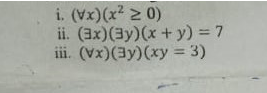
Q2: Find the truth values of each proposition. Rewrite in each words, where UD = set of integers.
Discrete Mathematics past paper 2022
Q3: Find the number of positive integers ≤ 1776 and divisible by two, three or five?
Q4: A fresh man has selected four courses and needs one more course for the next term There are 15 courses in English, 10 in French, and 6 in German she is illegible to take. In how many ways can she choose the fifth course?
Q5: Check the validity of the following arguments.
- Babies are illogical.
- Nobody is despised who can manage a crocodile.
- Illogical persons are despised.
- Babies can manage crocodiles?