
Let’s be brutally honest: In the world of tech, your brilliant code, your elegant algorithm, your flawless design—they are utterly worthless if you cannot communicate their value, explain their function, or collaborate on their creation. Communication Skills is not a “soft” subject. It is the hardest and most critical skill you will ever learn. This past paper isn’t about grammar; it’s a simulation for your career—testing if you can translate complex technical chaos into clarity, persuasion, and shared understanding.
Forget the idea that this is just about writing emails. This is about strategic human interaction in a professional environment. It’s the operating system that allows all your other technical software to run.
What This Paper Actually Assesses: Your Professional Translation Ability
1. The Core Challenge: Bridging the Gap
The foundational questions test your understanding of the fundamental problem: The Expert’s Curse. You know too much. The exam assesses if you can diagnose communication breakdowns:
- Between engineer and non-technical stakeholder
- Within a diverse, multidisciplinary team
- To a user via documentation or interface
You’ll be given a scenario of miscommunication and asked: “Identify the three primary barriers (semantic, psychological, organizational) and propose specific remedies.”
2. The Technical Toolkit: Precision in Practice
This is where theory meets the concrete demands of a computer scientist.
- Technical Writing & Documentation: You won’t just be told it’s important. You’ll do it.
- API Documentation: Write a clear, concise description for a function, including parameters, return values, and example usage.
- Software Requirements Specification (SRS) Fragment: Critique or write a section, focusing on clarity, unambiguity, and testability.
- User Manuals & READMEs: Translate technical steps into user-friendly, actionable instructions.
- Visual Communication: When a diagram is worth a thousand words. You’ll be asked to select or sketch the right visual model (flowchart, UML diagram, architecture block diagram, graph) to explain a system.
3. The Professional Scenarios: Navigating the Real World
The paper drops you into high-stakes, realistic situations:
- The Client Pitch: Condense a complex project proposal into a clear, persuasive executive summary. Focus on benefits, not just features.
- The Progress Report: Communicate project status to management—honestly addressing delays without inciting panic, using data to support your claims.
- The Code Review Feedback: Deliver constructive, specific criticism to a peer. The difference between “This function is messy” and “The
calculate()function has a cyclomatic complexity of 12; consider refactoring these three conditions into separate functions for testability.” - The Incident Post-Mortem: Write a blameless analysis that focuses on systemic causes and preventive measures, not individual fault.
4. The Human Dynamics: Listening, Teams, and Conflict
This section tests your emotional and social intelligence—the true differentiator.
- Active Listening & Effective Meetings: Distinguish between hearing and listening. Design an agenda for a sprint planning meeting that ensures all voices are heard.
- Intercultural & Cross-Functional Communication: How do you communicate effectively with a remote team in a different time zone and culture? How do you explain a database schema to a UI designer?
- Managing Conflict & Negotiation: Role-play scenarios. “A product manager insists on an unrealistic deadline. Draft your professional response, balancing feasibility with team morale.”
5. The Modern Digital Landscape
Communication today is multifaceted:
- Email Etiquette: Subject lines, tone, structure, and the dreaded “reply all.”
- Instant Messaging & Collaboration Tools (Slack, Teams): Understanding the difference between a channel message, a direct message, and when to schedule a call instead.
- Online Presence & Professionalism: Crafting a LinkedIn profile, participating in technical forums, and the permanence of digital communication.
The Paper’s Real Test: Adaptation and Audience Awareness
The hardest questions will give you the same technical content and ask you to present it to three different audiences:
- A technical lead (deep detail, algorithmic choices).
- A marketing manager (business value, user benefits).
- An end-user (simple steps, “what’s in it for me”).
This tests your core skill: audience analysis. You must shift vocabulary, detail level, and objective seamlessly.
How to Excel in This Past Paper:
- Adopt the “Audience First” Mantra. Before writing a single word, ask: Who is this for? What do they already know? What do they need to know? What do I want them to do?
- Practice the “So What?” Test. For every technical fact you state, force yourself to explain its implication. “We use a B-tree (what) so that search times remain logarithmic even with massive datasets (so what).”
- Structure is Everything. Use clear headings, bullet points, and the Bottom-Line-Up-Front (BLUF) principle for reports. Make your document scannable.
- Revise for Brevity and Clarity. Practice cutting 20% of the words from a paragraph without losing meaning. Eliminate jargon, passive voice, and ambiguity.
- Role-Play in Your Head. For scenario questions, literally picture the person you’re communicating with. How would they react to each sentence?
This past paper is your professional gateway. It certifies that you are not just a creator of technology, but an effective ambassador for your work. Mastering it means you have the single most impactful skill for leadership, collaboration, and career growth: the ability to turn complex ideas into common knowledge and shared purpose.
Communication skills Mid term Examination
Q1: What are the Barriers to Communication?
Q2: Discuss Non Verbal Clues?
Q3: Discuss Remembering and Feedback?
Sessional 1 past paper
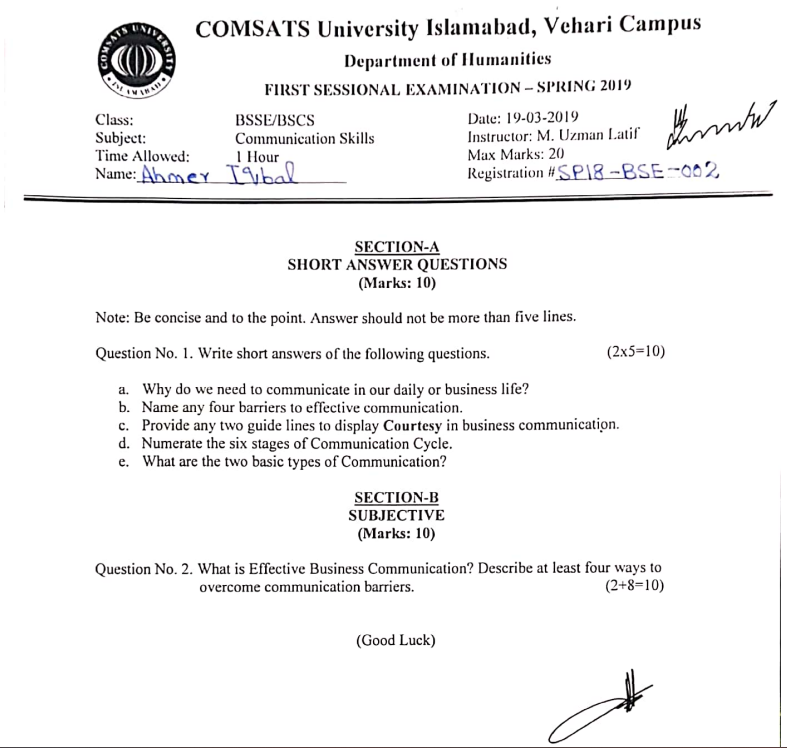
Sessional 2
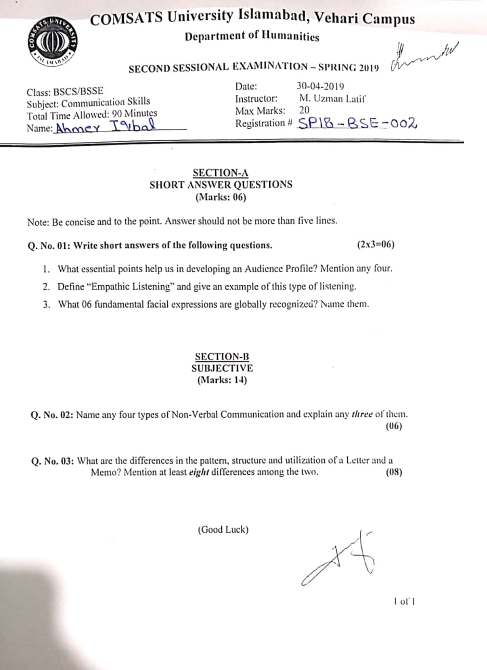
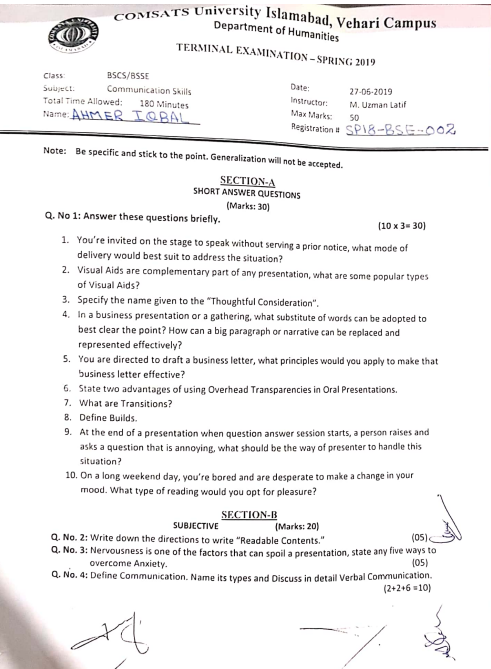
Final Paper
Sp22 Mid term paper
1. Difference between receptive skills and productive skills.
2. How many stages of writing process brief shortly?
3. Differentiate between you approach and plain English.
4. What is critical thinking?
5. Elaborate emphatic listening and describe benefits of emphatic listening. (2)
4: How do verbal and nonverbal forms of communication affect the students learning? 5